Divorce is awesome…
On unhappy marriages, the science of staying together for the kids, and why divorce is shameful when it shouldn't be.
Hello friend,
Why you’re getting this: this is my Friends Newsletter, a brain dump of interesting things that I send to interesting people I've met and friends I want to stay in touch with. Zero pressure to stick around—just click unsubscribe if you don’t want to get it (don’t worry, I won’t be notified).
👩💻 Victoria Vibe Coders Meetup: I’m hosting a casual meetup for any Victoria-based vibe coders on January 20th 9-10:30AM at Habit Coffee (Pandora location). Details and RSVP here.
I’m also HIRING an experienced vibe coder: I’m hiring a full-time vibe coder to work directly with me. You don’t have to actually know how to code (although helpful) but you must be an absolute super genius with Claude Code and similar tools. Email me if you’re interested with the subject line “Vibe Coder” and share 2-3 things you’ve built and a few bullets on your background. I don’t care about formal education, just scrappiness. Don’t say too much, just show me what you’ve built.
Here’s what I’m thinking about…
Divorce is awesome.
Yes, I know. Clutch your pearls and gasp.
Take a deep breath and bear with me here. I think I’m onto something…
We worship a strange idol in today’s society.
The idea that staying married, no matter how miserable, is noble.
That suffering together is somehow better than finding happiness apart.
Many people I know live quiet lives of desperation because of this.
Not everyone. But a good number of people I know are deeply unhappy in their marriages.
They feel unseen and unappreciated.
Like they’re always having to explain themselves, but never feel understood.
Like they live with the world’s most irritating and critical roommate.
In some cases, it’s subtle. In others, it’s severe.
It's almost like they have a job they hate—except they’re afraid to quit, so they have to share a bed with their boss until one of them dies.
They know how every conversation is going to go. Where it will stall and where it will blow up.
They’ve tried couples therapy.
They showed up and leaned in.
Learned how to use “I” statements and read the books.
And still, nothing changed.
Because no amount of therapy, communication tools, or self-work will resolve their relationship’s fundamental misalignments.
So what do they do?
They give up.
Not loudly, but bit by bit.
They stop bringing things up.
Stop hoping the next conversation will be different and become a quieter, smaller version of themselves—less playful, less open, and less affectionate.
They lower their expectations and let the romantic inside of them—the part of themselves who needs to be seen, heard, and held by a lover—quietly starve to death.
Some cauterize the wound in socially acceptable ways.
They spend all their time with friends.
They get obsessed with working out.
They find stimulation elsewhere.
Anything to avoid being alone with their disappointment.
Others numb it.
A glass of wine becomes a bottle.
A lingering glance becomes an affair.
Or worse, they simply turn off the part of themselves that hoped for more.
They’ve convinced themselves that they’re trapped.
When they open up to friends, they usually say they’re staying because they’re afraid of losing time with their kids or having to split their finances.
But for most, if you pull on the emotional thread, it's not actually about that—it's about shame.
About admitting they failed at the one relationship society told you was supposed to last forever.
The idea of all the other parents whispering about them at school drop off or becoming a cautionary tale at dinner parties.
Or having to tell their parents their marriage is over.
Why do we fear divorce?
Because even today, a time when over 40% of marriages dissolve, divorce is shockingly taboo.
There’s an assumption that marriage must be preserved at all costs—that avoiding the brief pain of divorce is worth decades of unhappiness.
What's bizarre is that breaking up isn't taboo if you aren't married.
Break up with your girlfriend of five years? You get an 'aww' and 'let's go out!'
Tell people you got divorced after five years of marriage and they react with judgement and disappointment.
“Did you try?” they ask in a hushed tone, their face ashen, like you've just confessed to a crime. “I know a great couples therapist I can introduce you to.”
It’s not just that they think it’s sad—that’s fine, it is sad—but that they often seem to think it’s morally wrong.
I got divorced about 4 years ago, and it was one of the best decisions I’ve ever made.
I went through all of this.
Do I regret my marriage?
Not for a second.
We have two beautiful sons. We had years of genuine love and laughter. I became who I am in part because of that relationship.
Of course, that doesn’t change the fact that we ended up not enjoying being married to one another.
We changed.
Not dramatically. We just grew into different people who wanted different lives.
The person I fell in love with when I was 27 wasn't the same person sitting across from me at 35.
Over time, the relationship shifted.
While we liked and loved one another, we didn’t enjoy having our lives intertwined.
We diverged in interests, preferences, and how we wanted our lives to unfold.
And these misalignments came out as blowups over a thousand innocuous decisions.
How to spend Saturday.
How to discipline the kids.
When to take the garbage out.
Each one became a tiny explosion, damaging the relationship. A meta-fight that was really about both of us being in a fundamental conflict that could never be resolved.
Eventually, we both drifted into frustration and stopped trying.
We became incompatible and unhappy. We stopped enjoying one another.
We tried it all: couples counselling. Date night. Taking space.
But in the end, it was simple: we’d just changed.
It just flat out didn’t work anymore and we were making one another miserable.
You know what’s hard about divorce? Breaking up.
Saying the words. Talking to lawyers. Separating assets. Telling the kids.
That stuff all sucks.
You know what’s awesome?
Everything after.
Rediscovering the hobbies you abandoned because they caused friction.
Getting to parent in your own style.
Finding a partner who makes you happy.
Freedom and self-actualization, on so many levels.
But don’t forget, this is as much for you as it is for your kids.
I love this line from Dr. James Hollis’ incredible book (one of my favorites from the last few years), Living An Examined Life:
“The greatest burden a child can bear is the unlived life of the parent.”
He means kids don’t grow up in your intentions—they live in your tone, your tension, and your patterns.
When parents stay in a marriage that’s quietly miserable, the house becomes a low-grade war zone: tension, sarcasm, silence, little detonations over nothing.
The child adapts by becoming an emotional accountant. Tracking moods, smoothing conflicts, shrinking their needs.
That’s the “unlived life.” Your fear of making a hard change becomes their job to manage in their own life and future relationships.
You might think I’m exaggerating here, but the science backs this up.
When my ex-wife and I were contemplating separating, I was particularly worried about how it would affect our kids.
I confided in a divorced friend about this, and here’s what he told me:
*“Here’s the hierarchy of what’s best for kids:
The ideal is two happy parents who are calm and loving in the same house.
The next best is two happy parents who are calm and loving living separately.
The worst of all, is two miserable parents fighting and modeling a bad relationship in the same house.”*
I went on to learn that this is backed up by studies.
Researchers tracked 96,000 families and found that kids whose parents stayed in unhappy marriages had higher rates of depression, anxiety, and self-harm than kids whose unhappy parents split up. Staying together was worse.
Another 12-year study found that kids in high-conflict homes actually did better after their parents split.
So many of us martyr ourselves "for the kids" and in doing so damage our children—teaching them that love looks like a festering garbage can of resentment.
And so often, the kids leave for college and the couple finally splits, leaving the children to rewrite their entire childhood.
*“So that's why Mom always seemed sad.”
“That's why Dad worked late every night.”
“Was my childhood a lie?”*
They knew. Kids always know. They just didn't have the words for what they were witnessing.
This quote nails the divorce conundrum:
*“Easy choices, hard life.
Hard choices, easy life.”
–Jerzy Gregorek*
Divorce is the ultimate hard choice.
You're signing up for six to twelve months of hell in exchange for forty years of freedom.
You're choosing to crawl through a sewage pipe for freedom like Andy Dufresne because you'd rather spend half a year in the muck than the rest of your life in a cell.
Yes, the conversation with your partner is brutal.
Telling your parents and friends is rough.
Facing the gossip and judgment from others stinks.
(Especially the unhappily married ones who see themselves in your decision and subconsciously hate you extra hard for it.)
Dealing with lawyers and splitting your assets is horrible.
And there’s no sugar coating this: your children’s reactions are the toughest part.
Then there’s the cherry on top of everything: moving out and restructuring your entire life.
All of these things suck. But they suck a lot less spending decades in an unhappy home.
We've collectively decided that divorce is shameful.
But compared to what?
Compared to modeling dysfunction to your kids?
Compared to resentment and bitterness?
Compared to teaching your children that love means suffering?
You know what’s worse than breaking your partner’s heart, upsetting your kids, dealing with gossip, and spending time with lawyers?
Spending decades in a home filled with resentment, where everyone slowly becomes a worse version of themselves.
It might feel selfish, but it’s for everyone else as much as you.
It will allow your partner to find someone who fits them better.
Enable your kids to grow up in two calmer, happier homes instead of one tense one.
And give everyone a real shot at peace—even if the path is rocky.
One of the main reasons that I got divorced was, when I looked around at all my friends, by far, the happiest people had ended their marriages.
It's an open secret among the divorced.
We see each other around and lean in conspiratorially: “Isn't it awesome?”
Almost universally, everyone is glad they separated.
We got to the light on the other end of the tunnel.
And on the other end is self-discovery.
New love and experiences.
Parenting the way you want to.
And often, an even deeper relationship with your kids.
Louis CK puts it well:
*“When your friend tells you they’re getting divorced, don’t go, ‘Oh, I’m sorry.’
That’s a stupid thing to say. It really is.
You’re making them feel bad for being really happy, which isn’t fair.
Let me explain something: divorce is always good news.
I know that sounds weird, but it’s true—because no good marriage has ever ended in divorce. It’s really that simple.
There’s never been a marriage where they were really happy, they just had a great thing, and then they got divorced.
That would be really sad.
But that has happened zero times. Literally zero!”*
Divorce is hard, but Louis is right.
It's sad and difficult. A hard transition.
But it's one of the best things that can happen to two wrong people and often results in increased happiness for you, your partner, and your children in the long term.
It isn't a failure. It's making a hard choice to have an easy life.
Refusing to sacrifice your remaining decades of life to protect society’s feelings.
And yes, like most hard things that require brutal honesty with yourself, it's wonderful in ways you cannot imagine from where you're standing now.
So maybe you should get divorced.
Not all of you, of course. Not if you're genuinely happy.
But if something in your chest just tightened while reading this?
Yeah. You should probably think about getting divorced.
PS: If anyone wants to talk, I’m here.
“The treasure you seek is in the cave you’re afraid to enter.”
–Joseph Campbell
Also, there’s a wonderful book on this topic called Sacred Cows: The Truth About Divorce and Marriage. I recommend checking it out if you find yourself thinking about this.
-
I loved this quote that my friend Kevin Rose shared in his newsletter the other day:
“When you fight something, you’re tied to it forever. As long as you’re fighting it, you’re giving it power.”
–Anthony de Mello
As somebody who frequently limits himself from eating unhealthy foods, alcohol, etc, I definitely relate to this quote. So often complete abstention leads to a painful obsession in the opposite direction.
Sidenote: I’ve been really enjoying Anthony de Mello’s book Stop Fixing Yourself on this topic. It’s a serious bucket of cold water over the head for anyone who’s an obsessive striver.
If you have ADHD, I highly recommend checking out a drug called Guanfacine.
It’s not a primary treatment, but something that you add on.
Vyvanse was a revelation for me. It gave me incredible focus and flow states, but it also revved up my anxiety in the evenings and sometimes made it difficult to sleep.
For the past six months or so, I’ve added Guanfacine XR (brand name Intuiniv) at night and my anxiety is almost non-existent (day or night).
It has given me this crazy, persistent zen-like calm that I’ve never felt. (I assume this is how people who don’t have ADHD feel?)
My anxiety before I started an SSRI was an 8/10.
The SSRI (Vortioxetine) took it to 4/10.
Guanfacine has dropped it to 1/10.
No matter what is going on in my life right now, I don’t feel particularly anxious.
Yes, I get stressed, but I don’t have anxious looping thoughts, sweaty palms, and all the typical symptoms I used to have 24/7.
I can’t identify any other reason why my anxiety would be this low other than that it perfectly lines up with adding this drug.
Not medical advice! Ask your doctor about it and do your own research. I also highly recommend this HubermanLab episode with Dr. John Kruse. It’s by far the best deep dive on treating ADHD and it inspired me to investigate Guanfacine.
Note: The Guanfacine doses for ADHD are much higher than dosing for other conditions, so make sure your doctor gives you the right prescription based on your body weight and also make sure you slowly increase your dose. I started at 1mg and increased by 1mg every 1-2 weeks until I reached my target dose and experienced zero side effects. ChatGPT helped me identify the correct dose.
I’m hosting a Think Week in April.
All year, you're busy.
Back-to-back meetings.
A never-ending conveyor belt of emails.
Mindless zooms.
Kids.
Bad sleep.
Rinse, repeat.
Think Week is an opportunity to disconnect with a curated group of fellow interesting people (entrepreneurs, creatives, scientists, and more) surrounded by stunning nature.
Here are the key ingredients:
Wonderful People
We are hand-selecting a crew of people we know well, but also opening up a few spots for interesting strangers. The kind of people who make everyone they interact with feel warm and gooey inside who are doing interesting things in the world. Some will be just starting out, others will be at later stages. This mix keeps it interesting for everyone.
Insight and Connection
Each day, we'll learn something, discuss something, and share an experience. We're going to have some sessions facilitated by a speaker, others will be facilitated by the group. We may also have a few mystery performers ;-)
Exceptional Food
No miserable conference food. Every meal will be delicious, every sip of coffee smooth (AeroPress + Mateina, obv).
Nature and Activities
The property has a sauna, cold plunge, pickleball court, ping pong, games room, and tons of amazing hikes nearby. We'll be getting lots of exercise and R&R time.
Our goal is that you leave with:
✅ 1 new friend
✅ 1 new idea
✅ 1 thing that changed your mind
✅ A feeling of calm and connection
If this sounds up your alley and you'd like to attend, then we're all ears.
Pricing is set based on the size of your income/company. Those of us with large businesses contribute more than those in the startup phase or in creative fields—we just think that's fair and it allows us to include an especially interesting mix of people from all walks of life.
Location to be shared once you’re accepted, but it’s about 45 minutes away from Victoria, Canada.
Apply to join here - we only have ~5 spots available for interesting strangers.
Is your house slowly poisoning you?
Mine was.
Here’s how I discovered the issue…
My friend Justin Mares is a complete health nut. He’s the brains behind companies like Kettle & Fire, TrueMed, and Perfect Keto.
Whenever Justin tells me about some new health concern, I usually roll my eyes and joke about tin foil hats.
He’s a good sport and takes it in stride—but within a few years I’m often eating humble pie. He’s usually right.
He’s an obsessive reader of science and always a few years ahead.
Recently, he told me about his new company, Lightwork.
They’re working on something that nobody is thinking enough about—yet.
Since the 1970s, houses have changed dramatically.
In an effort to drive energy efficiency, they've become airtight.
This is great for the environment, but terrible for your health.
All the particulates, VOCs, mold spores, and moisture that used to escape is now trapped inside with you.
Radon gas in your basement.
Mold spores from that leaky pipe in the wall.
Contaminants like PFAS quietly entering our water supply.
Your home has become a completely different environment than the one humans evolved to live in.
And the risks are almost designed to be ignored, because they’re so boring and innocuous.
You don’t feel them, but they build up quietly over decades of exposure.
A little more inflammation.
Worse sleep.
Headaches you chalk up to stress.
Brain fog you blame on getting older.
Hell, maybe a cancer diagnosis that came a little too young.
In the meantime, your house was silently contributing to it all along.
That’s what Justin’s new company is working on. Helping people test their homes and protect themselves from all these problems.
I consider myself pretty nerdy about this stuff. I had my air and water tested when I moved in, plus have air purifiers all over and a filtered water tap.
Lightwork goes a level deeper. They test for mold, VOCs, radon, lighting quality, and EMF.
They sent a crew and swept my house for hours, scraping walls, moving fancy looking sensors around, and taking water samples.
A few weeks later, we got the report.
Here's what they found in our home that I had missed:
They discovered crazy high volatile organic compounds in my shower water vapor.
The kind that get inhaled and absorbed through your skin and are linked to cancer, but easily resolved with a simple shower filter.
Something I never would have thought to test.
They also found EMF hotspots throughout certain rooms.
Including—of course—the kids bedroom.
This one got an exaggerated eye roll from me, to be honest.
I made some jokes about chemtrails and 5G, but then Justin sent me the literature.
I gulped and we made some changes.
I had no clue about either of these issues, and I'm someone who actually pays attention to this stuff.
Both were quick fixes and resolved within a few weeks.
I've talked to a bunch of friends about this.
The ones who've gotten their homes tested all have the same thought:
“It’s insane that nobody checks this stuff”
One found black mold behind a wall she’d walked past a thousand times.
Another discovered her son’s bedroom had the worst air quality in the house, full of VOCs.
A third had been being slowly poisoned by formaldehyde from cheap furniture.
Each was suffering from health issues, but none of them had connected their symptoms to their homes. In each case, they were an easy fix.
My friend who discovered the black mold, for example, realized it was the cause of her brutal brain fog and fatigue and was able to treat her mold exposure and recover.
It turns out that Benjamin Franklin was right: “An ounce of prevention is worth a pound of cure.”
So roll your eyes all you want, but I think Justin is on point on this one. You should get your house tested.
Since he’s a Friends Newsletter subscriber, he’s offering a 20% discount to all of his fellow readers when you book use this link 🫡
Random Stuff:
-
A guy detailed my car—then interviewed me for his podcast.
Sam’s company detailed my car and did an incredible job. Then, as I was paying, he caught me off guard and asked me if I’d be on his podcast (I didn’t expect a guy who runs a car detailing business to have one). I said sure.
We talked about all sorts of stuff:
- Why compounding is hard to believe
- ADHD as an entrepreneurial filter
- Being good at proficient, bad at exceptional
- Strategic laziness as a business advantage
- Why young entrepreneurs should avoid glamorous businesses early
- Spotting Narcissists and Psychopaths in Business
- The High Cost of People-PleasingAnd a bunch more.
You can listen to it here. Warning: the audio quality isn’t the best. YouTube / Spotify / Apple Podcasts
Also: if you’re based in Victoria and have a car that needs detailing, his company Canine Car Care is very good (and dog-friendly).
-
I made a winter playlist on Spotify full of cozy semi-depressing tunes for a rainy/snowy day. Listen here
-
A random thought: Using Google Search in 2026 is like using the Yellow Pages in 2004.
-
I was absolutely fascinated by this interview with Dr. Kevin Tracy on The Tim Ferriss Show. He is treating rheumatoid arthritis using vagus nerve stimulator implants the size of a grain of rice. The stories are remarkable, and the science to back it up is real. So interesting.
Listen here: Spotify / Apple Podcasts
-
If you don’t already, follow me on Instagram. That is all.
-
Victoria stuff:
-
I’m obsessed with a new sauna place called Aerth in James Bay. My favorite feature: they have two saunas: the social sauna and the quiet sauna. Go in the social sauna, and you’re opting in to talking to strangers, which is one of my favorite pastimes. Check them out
-
There’s a really great new pasta place called Lumache on Douglas. We went with some friends and were really impressed.
-
I’m biased, because I’m a co-owner, but the team at Part & Parcel is on fire lately. The tasting menu is mind-bogglingly tasty. I highly recommend you go check it out. Also: It was just announced that our head chef, Nick, will be on the next season of Top Chef Canada!
-
There’s a new hot pot place called Big Way Hot Pot that just opened near UVIC. It’s a neat concept: you get to fill your pot from a huge wall filled with meats, tofu, noodles, and veggies, then they cook it for you and deliver it to your table. It’s very casual, but very tasty.
-
That’s all for now…
-Andrew
Want to read more? Here are a few of my best past issues:
- I lost ten million dollars doing something stupid
- How I Succeed by Starting Companies That (Mostly) Fail
- I committed email suicide.
- You should ignore your kids.
- Read more past issues here.
Did you enjoy this newsletter? Say thanks by checking out one of my businesses:
- Find a designer on Dribbble
- Make the perfect morning coffee using an AeroPress
- Review a movie on Letterboxd
- Get hyper-caffeinated on Mateina
- Buy a bronze bust of Charlie Munger or Warren Buffett
- Hire Metalab to design or build your next app or website
- Or go check out one of our many other business
Follow me on X: @awilkinson
Follow me on Instagram: @awilkinson
Forwarded this message? Sign up here.
Unsubscribe · Preferences
Andrew · Victoria · January 8, 2026
Read next
Have babies with the wrong person…
On the birth of my daughter, why young people are obsessed with the prep work of dating but refuse to eat the meal, and why you should just have the freaking baby.
ReadHave babies with the wrong person
On the birth of my daughter, why young people are obsessed with the prep work of dating but refuse to eat the meal, and why you should just have the freaking baby.
ReadI gave $16 million dollars away
What I learned about giving money away—and why scientific research is the part of philanthropy that feels most like venture capital.
Read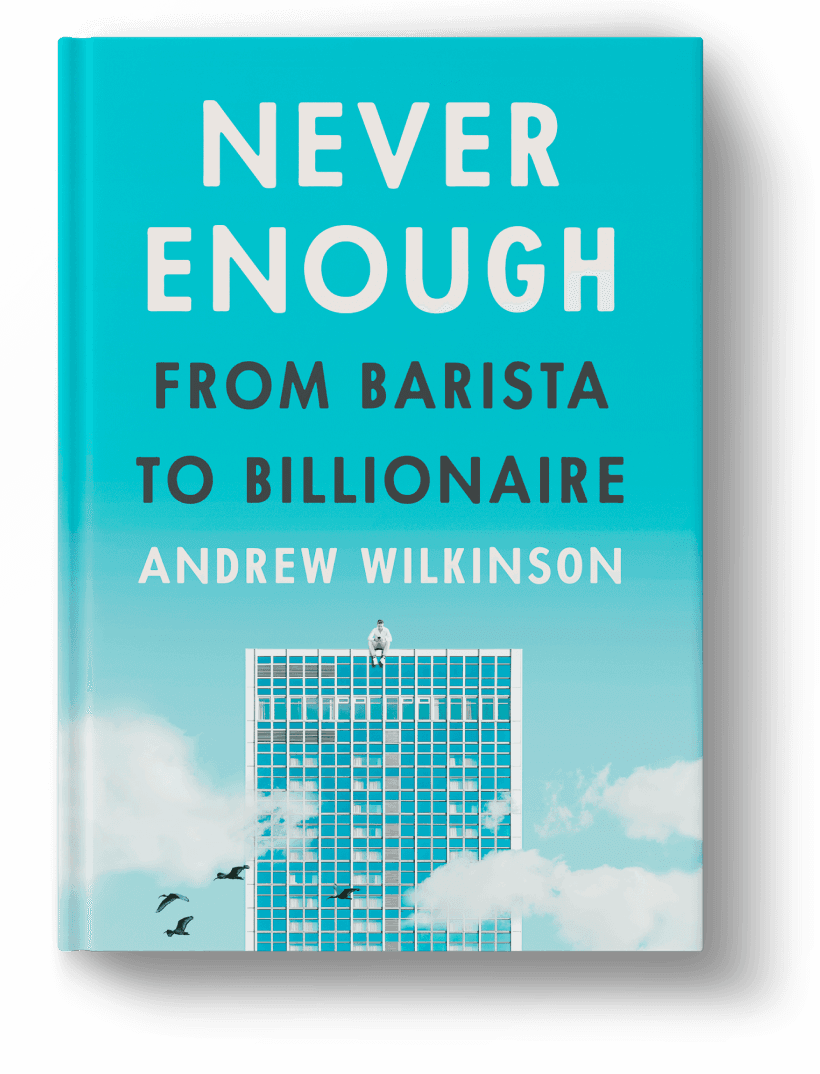
The book
I wrote a book.
288 pages on why having a lot didn’t fix anything. Out now in hardcover, ebook, and audiobook.
Read about the bookKeep reading
Get the next issue in your inbox.
Thirty thousand people read it.