Have babies with the wrong person
Last Tuesday at 11:43pm, Zoe gave birth to our daughter.
She came out looking like an alien.
The umbilical cord still beating, covered in blood. Her head shaped like a cone from an hour of being pushed through the birth canal.
Then I held her against my skin.
Suddenly, my brain was flooded with some magical, baby-induced opioid.
The world stopped and all my existential anxieties disappeared.
What's interesting is that I was kind of terrified of having another baby.
I wanted to have another child, obviously.
Logically, I knew I wanted more kids. Especially my first daughter.
But I'm 40 years old. My boys are 6 and 9, and I'd moved into a chiller phase of parenting. One that didn't involve disrupted sleep, crying, or diaper blowouts.
For most of the 9 months before her birth, I was stressing about it.
The thought running on loop:
All I want is freedom, and here I am building a baby jail for myself.
I was ready to travel. Wander. Go crazy. Stop being so responsible.
I could be dead in 40 years, for Christ's sake!
A third kid made logical sense, but the logistics themselves seemed nightmarish.
And then I held her and my concerns disappeared.
The treasure I was seeking was in the cave I was afraid to enter.
Imagine if you met someone who said, "I love cooking. But I have no interest in tasting the food I make. Not even a bite."
You'd think they'd lost their goddamned mind.
Sure, cooking itself is enjoyable.
The tap tap tap of the knife on the cutting board.
The smell of garlic catching oil.
The sizzle of a deglazing pot.
But the greatest joy isn't the cooking. It's getting to enjoy the meal you created from a mishmash of ingredients that came together perfectly.
Sitting down with your family. Hearing the collective "Mmmmms."
This is what young people are doing with sex.
I know that sounds weird, but bear with me here.
When you're young, without thinking about it, you obsess over two things:
- Looking attractive.
- Generating status.
You want to be fit, hot, and successful.
You want to look like someone worth mating with. Almost all of it is subconscious.
Men do shoulder presses to widen their shoulders.
They buy expensive watches and luxury cars to awkwardly signal success and resources.
They lie about their height on dating apps and overstate their salaries.
On the flip side, women starve themselves to fit into smaller jeans.
They obsess over hair and skincare, and do squats to perfect their hip-to-waist ratios.
All of it is to advertise one of two things: good genes or good resources.
What drives this behavior? The science is pretty definitive:
Across 37 cultures, women rate ambition, height, and earning power as the top traits in a man. They want their men 8 inches taller than them, and to out-earn them — a preference that holds even as women's earning power catches up.
Men, in the meantime, from age 25 to 85, converge on the exact same hourglass shape as most attractive — a waist-to-hip ratio of 0.7. The same number in every country on earth.
Both sexes obsess over skin so deeply that when researchers showed people a postage-stamp patch of cheek skin with no other features visible, the rating of that tiny patch alone predicted the rating of the whole face.
Why does skin matter so much? Because clear skin signals a strong immune system — and a strong immune system signals three things at once:
- You'll live long enough to raise a child.
- You'll pass strong immunity to that child.
- You're less likely to transmit disease to a partner.
We don't think about it consciously. Our bodies just instinctively know.
All of this effort — from shoulder presses to Rolexes to the $300/mo skincare routine — points at the same biological outcome:
To be sexually attractive = to be fit for mating.
Our bodies are screaming something at us over and over again:
Make a healthy baby!
The cooking, the spice, the chemistry, the chase — all of it is just prep work. Mise en place.
The meal, the final stage, the thing that delivers the payoff, is the child.
And yet, young people these days are obsessed with the prep but refusing to eat. Fewer and fewer of them seem to want to have children of their own.
The usual arguments:
"I'd rather focus on my career" "I want to travel" "It's expensive"
And what are they getting in exchange for this freedom?
Misery. Loneliness. Antidepressants for breakfast.
The default state of most people is alone in a room watching strangers on a phone.
Their bellies are full of the optionality they thought they wanted. They are master chefs starving at their own counters, packed with food they won't eat.
Why? Because you might care about freedom, but your biology doesn't.
When I was still married to my first wife, there was a family tradition of eating dinner at her grandmother's every Friday night.
She was in her 90s by this point, and she'd had her first kid in her early twenties and just kept going, ultimately having five children who all went on to have children and grandchildren of their own.
Her house was always buzzing with dozens of family members. Three generations of people who came from her womb, ranging from tiny babies to sulking teenagers to fifty-year-olds.
While everyone bounced around her, filling plates of food, comforting crying babies, and trying to herd the pack of children, she'd just sit watching the scene in a big cushy chair in the corner with a serene smile.
I'd never seen someone look so deeply calm and satisfied.
It seemed odd to my twenty-seven-year-old self. The one who was obsessed with building a business and making something of myself.
Here was an old lady, happier than I'd ever been, watching a bunch of stinky kids run around.
She hadn't built a Fortune 500 company or won a gold medal at the Olympics.
She hadn't traveled the world or climbed mountains.
Instead, she just raised a bunch of kids.
But when I had my first son at 31, I suddenly understood her smile.
My first thought upon having kids was that I wished I'd done it younger.
That I hadn't delayed this wonderful feeling for so many years in my mid to late twenties, chasing late nights and exotic trips that never delivered the hit I wanted.
Where I used to be jealous of people who were more successful than me, now I was jealous of people who had kids in their twenties.
People who would get to know their great-grandchildren.
This is why you should have kids as young as possible with the wrong person.
Not a cruel person, not someone who'd be a shitty parent, not a stranger you met on Tinder who has a weird katana collection.
I mean: the not-quite-right one.
The one your friends say is "great but…"
The one who'd be a good Dad or Mom, but isn't the soulmate you were promised.
After all, as I've written about, I got divorced.
Do I regret having kids? Not for a second.
My kids are the biggest win of my entire life.
The relationship doesn't have to last in order for the kids to be worth it.
Babies hit a part of your brain nothing else can reach.
It's biology. Every other thing in your body works this way.
You have a craving, and when you satisfy it, you feel good.
Eating when you're hungry. Sleeping when you're tired. Sex when you're horny. Hanging with your friends when you're lonely. Going for a run after a week sitting still.
Why would the biggest drive — the one our entire biology is organized around — be any different?
It isn't.
Last week, I had one of those days.
The kind where it feels like your head is a pressure cooker that's moments away from exploding.
Not enough sleep. Too many texts. Too many emails. Too many household tasks I'd forgotten about.
I felt like if one more person asked me for one more thing, I was going to fucking blow.
I was dreading bedtime with the boys.
They were screaming. Running. Getting water all over the bathroom floor and shrieking.
I managed to hold it together.
I got them into the bath. Brushed their teeth. Tucked them into bed. Turned out the lights.
Then my 6-year-old rolled over, pushed his forehead into my chest, and let out a long sigh and sank into me.
I could feel his heartbeat through his pajamas, and within a minute he was conked out, snoring on me.
And suddenly — bizarrely — all was right in the world.
No drugs. No therapy. Just a small person who needed me.
It's the ultimate shortcut. Easier than climbing a mountain, building a company, or the other absurd things people do to fill that cup.
No amount of trips to Bali, writing workshops, or run clubs can fill it.
Only babies.
This post might piss you off.
Maybe you can't have kids. Maybe you flat out reject my pseudo-Darwinian worldview.
Fair.
If that's the case, you can adapt what I'm saying into a paradox:
Meaning comes from being needed and caring for others.
Anyone who has had a dog knows this.
Having a dog logistically blows — you're home by 5pm to feed them, walking them at 7-8pm, dropping mountains of cash at the vet at random. And yet, existential satisfaction washes over you.
But imagine TikTok influencers claiming society tricked us into getting dogs to steal our freedom (as they do about having children).
People would LOSE it. They'd be outraged.
Because while owning a dog objectively makes life worse, it subjectively makes you happier.
Any dog owner will tell you this.
And it's like that with kids, times a thousand. The data backs this up.
Two researchers at UC Riverside ran a study in 2013. Across all measures, parents reported more positive emotion and more meaning than non-parents. And they reported feeling more positive while caring for their kids than during anything else they did.
And here's the best part:
When you measure actual, objective moment-to-moment happiness, a 2014 study of 1.7 million Americans found that parents score way lower than non-parents on day-to-day satisfaction.
Parents have more of all the bad stuff.
More worry. More stress. More anger.
By every objective metric, parents' lives are harder than non-parents.
But by every subjective metric of meaning, their lives are better.
Despite all the extra stress, 93% of American parents over 45 say they are glad they had kids and a 2021 survey found that 1 in 3 Americans wish they'd had more kids.
So should you shack up with a random and have kids?
The caveat first.
Some people are infertile or have complex health problems.
Some don't have a partner.
Some are still doing the work to be safe parents themselves.
Some really, truly just flat out don't want kids, and that's fair.
But for the rest of you — those who are on the fence, in good-enough relationships, with some financial stability, who keep telling yourselves not yet, not quite, not until I'm sure, not until that promotion:
Just have the freaking baby.
Stop waiting for the perfect person or for your apartment to be bigger.
Stop waiting for the version of yourself who has it figured out.
Because that version is never showing up.
As I'm writing this, it's early in the morning and I'm tired.
I woke up early to take the baby so Zoe could try to scrape out a few precious hours of sleep upstairs.
I'm using voice dictation in a big plush easy chair in our den, with our daughter asleep in the crook of my arm.
The top of her head smells like that smell that all babies seem to have: rose petals and chocolate.
Every minute or so she lets out a funny little gasp or hiccup as she wriggles around in her sleep. Dreaming about nipples or whatever it is newborns dream about.
The boys are joyfully beating on each other somewhere down the hall.
I keep watching her breathe and grinning like an idiot.
And I cannot, for the life of me, remember what I was afraid of.
Andrew · Victoria · May 27, 2026
Read next
Have babies with the wrong person…
On the birth of my daughter, why young people are obsessed with the prep work of dating but refuse to eat the meal, and why you should just have the freaking baby.
ReadFight with a pulse oximeter
How John Gottman's Aftermath of a Fight conversation plus a $20 pulse-ox sensor turned our worst arguments into something productive.
ReadDivorce is awesome…
On unhappy marriages, the science of staying together for the kids, and why divorce is shameful when it shouldn't be.
Read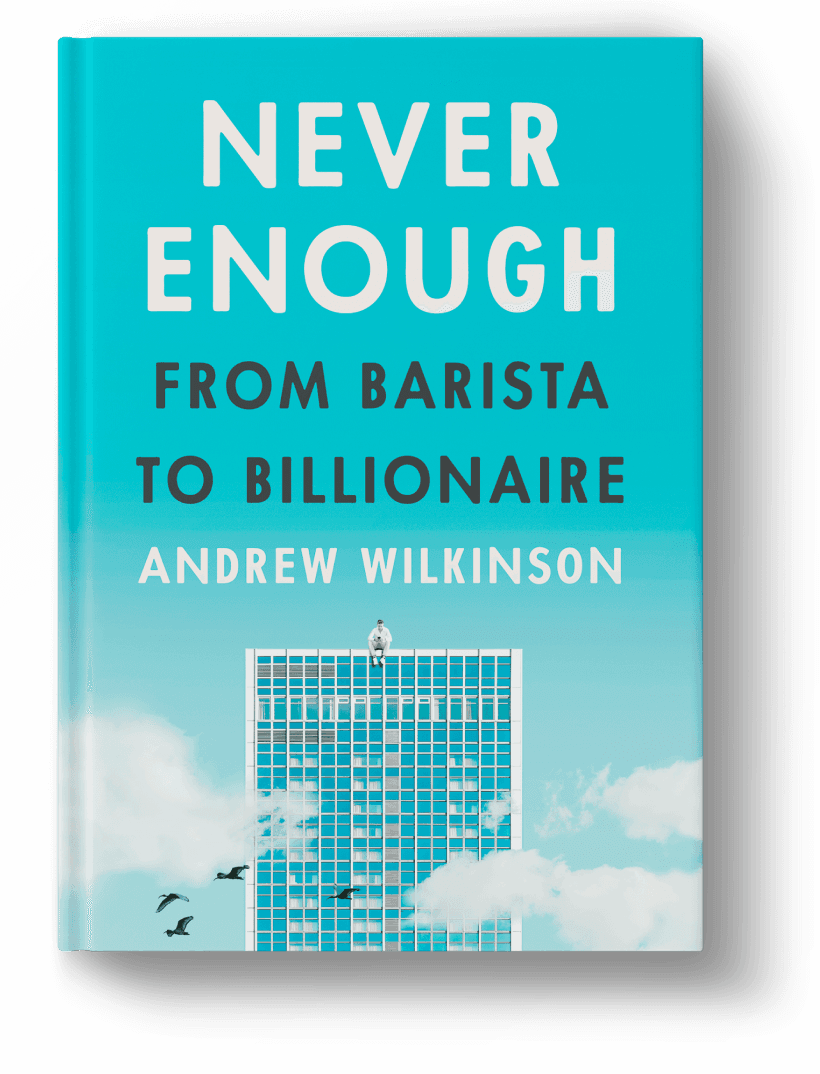
The book
I wrote a book.
320 pages on why having a lot didn’t fix anything. Out now in hardcover, ebook, and audiobook.
Read about the bookKeep reading
The newsletter is free.
Thirty thousand people read it.