Your business shouldn't do good
Your business shouldn't do good…
It should maximize profit and forget the kumbaya stuff.
In fact, trying to help people might be the most selfish thing you can do.
This might sound evil—but hear me out…
I might have ruined a perfectly nice young entrepreneur last week.
He runs a web design agency, and a mutual friend suggested we connect.
"We mostly work with small businesses around Victoria," he told me. "The local spots. They don't have much budget, but that's kind of the point."
I could already see where this was going.
"That's great," I said. "What do you charge them?"
"We keep our prices as low as possible. Around $2,000 a month. I know we could charge way more if we went after bigger companies, but that's not what this is about."
He said this with such genuine conviction that I felt like an asshole for what I was about to say.
"But... they don't have any money," I said.
"So? That's exactly why they need our help."
I took a breath. Here we go.
"I'm about to say something that sounds completely backwards," I said. "But what if charging less is actually the selfish move?"
He crossed his arms. The defensive wall was going up. I could see it happening in real-time.
"How could helping small businesses possibly be bad?"
I've had this exact conversation probably twenty times.
Young, idealistic entrepreneur. Good heart. Terrible business model.
And every time, I sound like Gordon Gekko about to launch into the "Greed is Good" speech.
But I tried anyway.
"Ok, let's do the math. How many small businesses can you realistically work with at once?"
He thought about it. "Maybe five, if we're doing good work."
"And what's the most they can pay?"
"Like I said, about $2,000 per month is their limit. Any more and they just can't afford it."
"So that's $10,000 a month total, $120,000 a year. After paying two employees a reasonable wage and your expenses, you're left with maybe $10,000 profit. Maybe."
He nodded reluctantly.
"Look, it's not about the money—"
"Hang on," I interrupted. "Now imagine you take on five corporate clients instead. Accounting firms, wealth managers, tech startups. They can easily pay $10,000 a month each. How much is that annually?"
He did the math in his head. "That's... $600,000 a year."
"With the same expenses, that's $490,000 in profit. Compare that to your current $10,000. Now here's my question: what could you do with an extra $480,000 a year?"
"I mean... a lot. But that's not—"
"Humor me. Think about it. How could you use it to help small businesses?"
He paused. I could see him trying to figure out if this was a trap.
"I guess I could hire someone to do free work for small businesses."
"How many small businesses could one person help per year?"
"If they're doing quality work? Maybe ten to fifteen."
"So instead of directly helping five businesses at break-even, you could help fifteen through the person you fund. Plus you still have hundreds of thousands left over. You could give small business grants. Maybe you fund someone to create free resources for entrepreneurs. The options multiply."
I could see him processing this. But I also knew what was coming next.
"Here's the thing," he said. "That's all theoretical. What if I just take the corporate money and... don't do any of that? What if making that much money changes what I care about? I've seen it happen."
"Sure," I said. "It happens all the time. People tell themselves they'll make money first, help people later, and later never comes. Or they get used to the lifestyle and suddenly $490,000 doesn't feel like that much. But that's a test for you: how serious are you about helping the world?"
He was quiet.
"There's something else too. Right now you're helping five businesses limp along. But you're also barely surviving. What happens when you burn out? What happens when one of your kids needs braces or you have a health issue? Your entire model depends on you sacrificing indefinitely. That's not sustainable for you, and it's fragile for your clients."
"So what's the alternative? Just... sell out?"
"No, but you need to separate your business model from your philanthropy. A struggling 'do-good' business that collapses helps nobody. A profitable business run by someone with values can deploy those profits into doing good."
I could see him wrestling with it.
"You know Patagonia?" I asked.
"The clothing company?"
"Right. They charge premium prices. $800 jackets that probably cost $100 to make. But they've turned their environmental values into their margin advantage. Their customers pay high prices specifically because Patagonia has proven they'll use those profits for environmental causes and buying their clothing makes them feel good about themselves. As a result, they've protected over 15 million acres of wildlife habitat."
"That feels different though. They're selling to rich people who can afford it."
"Exactly. Robin Hood! Take from the rich and give to the poor. They're not undercharging wealthy customers out of some misplaced sense of fairness, or selling high quality jackets to underprivileged people at cost. They're extracting maximum value from people who have it, then redirecting the money toward their mission. That's the model."
"So what do I do?" he asked.
"You need to decide whether you want to feel like a good person today or defer it for the long term and have more impact. Because in your case, I don't think you can do both."
I had to run to my next meeting. We said goodbye and I left him there, staring at his laptop.
Walking back to my car, I felt guilty.
I believed in what I said, but it's a counter-intuitive argument—telling somebody to forgo helping those in immediate need in order to help abstract people in the future.
Am I the asshole?
Originally published in the Your business shouldn't do good. issue of Never Enough.

Andrew · Victoria · October 9, 2025
Read next
I gave $16 million dollars away
What I learned about giving money away—and why scientific research is the part of philanthropy that feels most like venture capital.
ReadI spent 25 years treating the wrong thing
On waking up in Maui certain I had cancer, the little pink pill that finally turned my brain into a library, and the prison most of us live in without realizing the door is unlocked.
ReadI wasted my twenties...
What ADHD treatment, $16M of philanthropy, beta blockers, and the right contact lenses taught me about not spending decades trying to fix the wrong problem.
Read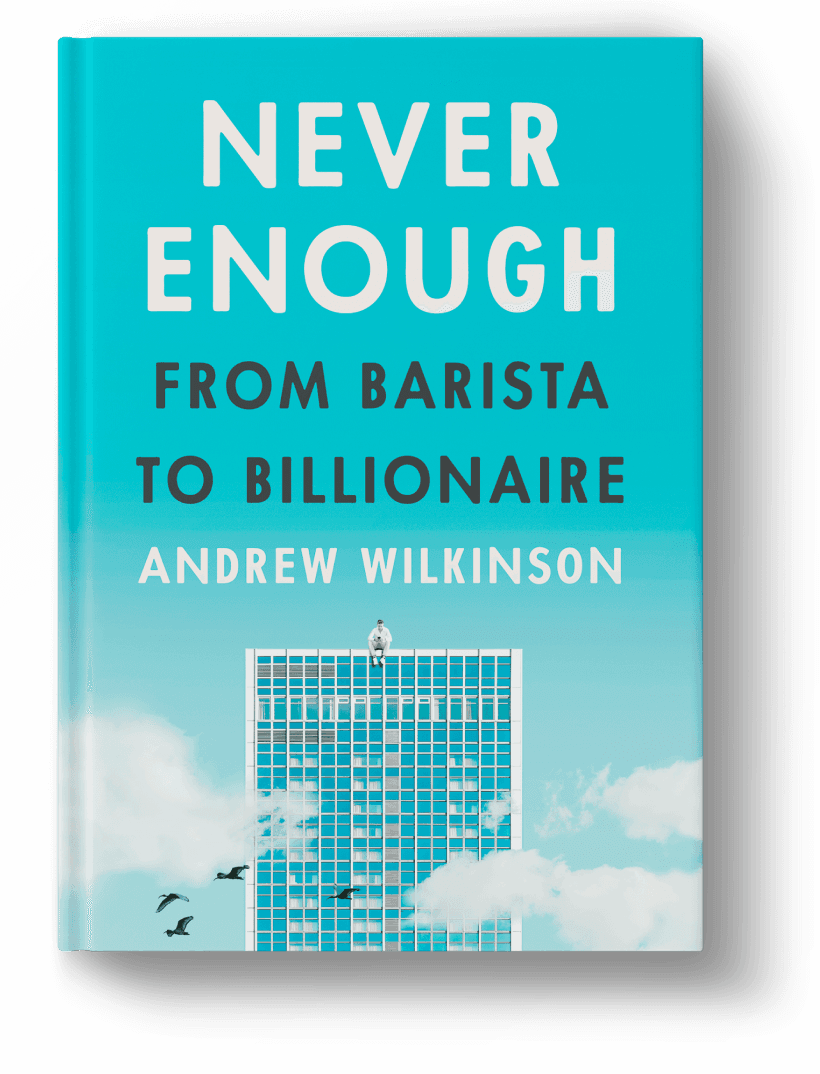
The book
I wrote a book.
320 pages on why having a lot didn’t fix anything. Out now in hardcover, ebook, and audiobook.
Read about the bookKeep reading
The newsletter is free.
Thirty thousand people read it.