I spent 25 years treating the wrong thing
I'm a miserable person.
On the third day in Maui, Zoe asked me a question—something innocuous, what time was our dinner reservation—and I snapped.
I had been reading the same paragraph in a book for ten minutes, my eyes scanning but nothing landing, and my reaction came out like a snarl, confusing both of us.
That night, after dinner, as we sat on the patio drinking tea and gazing out at the sunset over the palm trees, my hands crawled with anxiety. I was certain I had cancer.
In addition to that, more quietly, I had convinced myself that a comment I'd made to a friend over lunch two weeks earlier had cost me the friendship. I ran the sentence on a loop in my head, like a tongue over a newly chipped tooth.
I was in paradise. Maui. My favorite place in the world. But I had stopped taking my medication eleven days before.
As an experiment, I had decided to stop taking the little pink pill every day—after all, I was happy now. I'd worked through my stuff, done a lot of therapy, and I probably didn't need it anymore.
I had forgotten that, by default, I am a miserable person.
I worry obsessively about what could go wrong, or worse, about what I don't have that I need. My brain lives in the future, and spends every second of every hour thinking about how I'll feel better once X, Y, or Z happens.
Make enough money. Meet the right woman. Go to Hawaii. Or, on a different day: if I don't plan and control everything, something terrible is coming. So I loop on the thing until I've solved it. Then my brain finds a new thing to torture me with.
Rinse, repeat.
This is the itch that drove me for decades. It was useful in some ways—it made me successful.
Built a business. Dated women whose patience I was using up. Bought fancy sports cars. Built my dream house. Got the professional accolades. Optimized my biomarkers to the 99th percentile.
My insides—the upper stomach, the place between the sternum and the throat—were always churning. The itch persisted. The feeling of impending doom.
The problem was: no matter where I went, or what I achieved, my brain came with me.
My cruel, ever present master.
I built a narrative around all of this, the way most of us do, and I wrote about it in my book, Never Enough.
I psychoanalyzed myself. Did Jungian talk therapy to try to muddle through what caused my strange behavior.
From a young age I had learned that I would always let someone down—a teacher, my mother, and as I got older, a boss.
I couldn't deliver anything unless I was 110 percent into it. My brain was the world's worst version of FedEx: losing packages, or just throwing them in a dumpster because I didn't want to deliver them.
The narrative I built was that my parents argued about money, my nervous system got tuned up and stressed out, I became parentified and avoidant.
There is truth to that. But it was never the whole truth.
What I learned later, in a story I told elsewhere, is that I have a brain disorder. ADHD.
It turns out that ADHD lives in your DNA. It runs in families in the same way that height does. If one of your parents has it, the odds you have it too are closer to a coin flip than to a long shot.
I watch my boys, six and eight, gyrate through the house, and I wonder. I do not want them to grow up the way I did—feeling broken, feeling bad at school, for reasons nobody had named yet.
What does it look like?
Opening the refrigerator and standing there for forty seconds, having forgotten what I came for.
A tidal wave of overwhelm on an ordinary Tuesday—too many tabs, no through-line.
There's a part of ADHD that work hides. At the office you have an assistant, executives, a team of grown-ups paid to catch the things you drop. You look organized. You are organized—by proxy. Then you come home, and there is no team.
The bills, the calls, the doctor's appointment you said you'd book three weeks ago, the conversation your wife has been waiting for you to come back to—these are the costs the marriage pays for a disorder the business doesn't.
So, looking back: I sacrificed two and a half decades trying to build a solution to the pain inside my head—achievement, money, travel, stuff—when it turned out the problem was solved by taking a little pink pill every morning.
What no one had told me, what I had not been able to imagine, was what my brain felt like once it was treated.
The inside of my head had been Times Square, all night, every night, for as long as I could remember. Vyvanse turned it into a library.
An SSRI took my anxiety from a nine to a six.
This past March, my doctor added Guanfacine, and the six dropped to one.
I read a book, all the way through, in the order the words appeared. I sat through a dinner without auditing a sentence I'd said two weeks earlier. I had not known what ordinary calm felt like. I had assumed everyone else was faking theirs.
Someone asked me recently if the pills might shorten my life. I told them I'd rather live a decade shorter than feel the way I'd felt every day.
Imagine you had seasonal allergies, and instead of taking a Reactine you spent twenty-five years getting a series of radical sinus surgeries. The recoveries went sideways. The complications stacked up. You spent your forties recovering from a problem that had never really been there.
If only you'd taken the bloody allergy pill.
That's a little bit how I feel.
I mourn the fact that I lost my youth. I spent it running marathons to cure a headache. I built businesses to cure it. Bought houses to cure it. Crossed oceans to cure it. None of it was ever the medicine.
I was talking to a young entrepreneur the other day, and he said, "Sure, but if you'd treated your ADHD you wouldn't have all this." He gestured at the house—the view, the stuff.
"Yeah," I said. "But I would have had my twenties."
Like, technically, I existed in my twenties. But I lived in the future. I spent all my time living in a nightmarish future where everything was horrible. I couldn't relax. I couldn't be present.
If you've felt an itch—the looping, the brain that won't quiet, the feeling that something is wrong with you that nobody has named yet—please don't take twenty-five years to find out.
So many people I know are living in a prison inside their own mind, not realizing the door is unlocked. ADHD, OCD, autism, anxiety: most of these have treatments. They don't require courage. They require a doctor or therapist.
I built Deep Personality, partly to help people see what I couldn't see in myself for two and a half decades.
It's not a cure, but it can give you a map to figure out what is driving your itch and direct you to the most effective treatments.
Moving to Bali will not cure your anxiety. Getting rich will not fix your depression and loneliness. Perfectly organizing your desk until it looks like a Wes Anderson movie will not rid you of OCD.
If anything in this piece felt familiar, spend 45 minutes and find out. Take the test.
Originally published in the I wasted my twenties... issue of Never Enough.
Andrew · Victoria · April 29, 2026
Read next
What do people say behind your back?
A few years ago I paid Jack Skeen to interview the people closest to me and write a 360 of my life. Then I built Forum360 so my forums could do the same thing once a year.
ReadI gave $16 million dollars away
What I learned about giving money away—and why scientific research is the part of philanthropy that feels most like venture capital.
ReadRewriting fear
When you recall a fear and your body doesn't panic, your brain re-files the memory as 'not a big deal.' That's how I went from sweating through my shirt to cool as a cucumber.
Read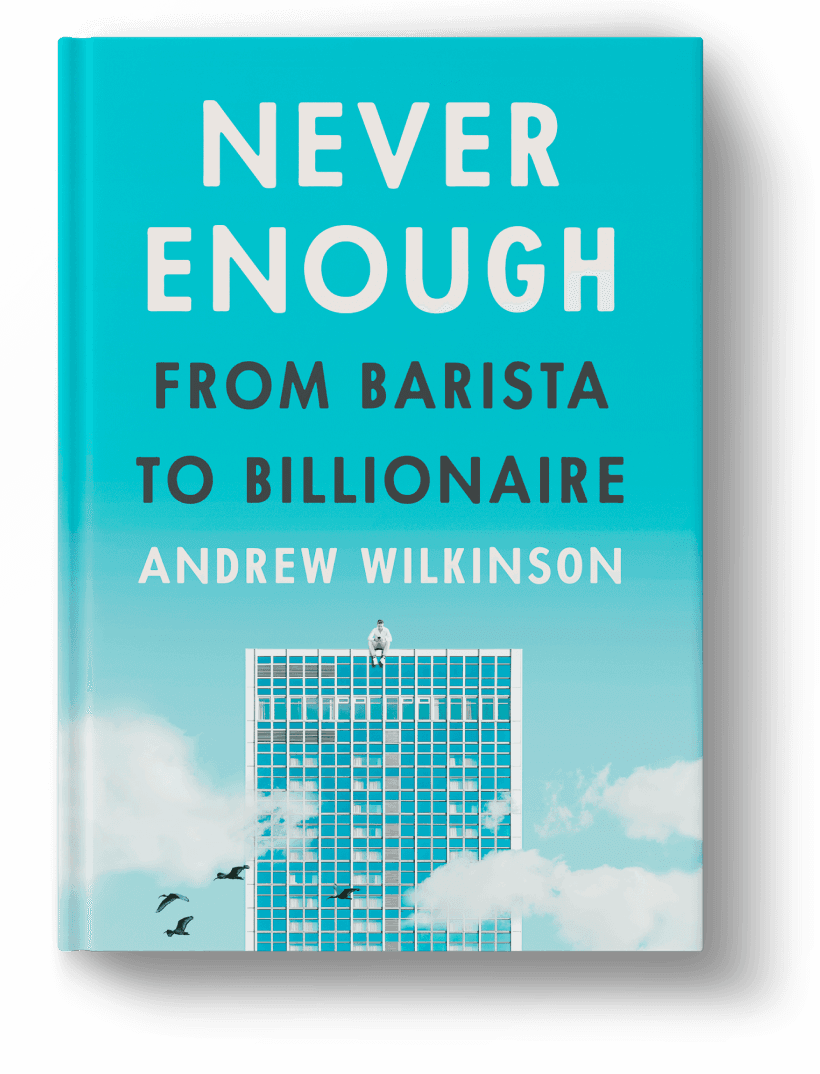
The book
I wrote a book.
288 pages on why having a lot didn’t fix anything. Out now in hardcover, ebook, and audiobook.
Read about the bookKeep reading
The newsletter is free.
Thirty thousand people read it.