Pascal's wager for AI
AI is exciting, but also terrifying.
It could create a future where most labour is effectively free and we can all just hang out and play pickleball.
Or, total annihilation and chaos. Fun!
Over the past two years, I've spent the majority of my time thinking about it. Reading every book I can on the topic (my favorite is The Coming Wave by Mustafa Suleyman) and learning how to use all the tools.
My approach to AI is a little like Pascal's Wager—the idea that you should believe in God as a way to hedge your bets. Pascal's argument is that if you die, and heaven is real, you get to go there, versus eternal damnation. If you die and it's not real, you lose nothing.
If you think my analogy comparing God to AI is a bit extreme, consider this scenario:
Imagine we just discovered that an advanced alien race is headed for earth and, at its current speed, will arrive some time around 2030. We know that it is infinitely smarter than us, and we have no idea whether it will be our friend or foe.
Pretty godlike, right? How would you feel?
However you would feel is how you should feel about AI.
Like Pascal, I've chosen to assume that artificial super-intelligence is coming in the next five to ten years, and I'm prepping accordingly.
There's two ways I'm preparing:
-
I've invested in a company called IREN as a "hedge" (way to profit if AI disrupts everything).
I shared my thesis on My First Million, then in an X post back in February, and the stock has been on an absolute tear, up 336% since.
TLDR: IREN started out as a Bitcoin mining company. Over the last decade, they secured access to an insane amount of power (electricity) and they are building massive datacenters in Texas.
It controls enough electricity to power San Francisco three times over and, in the race to AI super-intelligence, power and computing are in insanely high demand. Once completed, these datacenters should make the stock worth somewhere between $80-$300+ per share (depending on how AI plays out), and the datacenters they're building are valuable in any scenario, even if AI cools and super intelligence doesn't play out.
As my friend Mohnish Pabrai says:
"Heads, I win big; tails, I don't lose much."
I just wrote another post on X sharing that I still think the company is highly undervalued and a great way to hedge against / bet on AI without the valuation risk of companies like Nvidia and OpenAI.
Not investment advice, do your own research!
-
I've been obsessively learning how to build AI agents.
I don't love that term, I actually prefer the term Digital Employees. Over the past six months, I've been using Lindy to automate all of the torturous administrative tasks that previously required someone from my team.
To be clear: this is not about removing jobs. It's about removing tasks that are mindless and boring.
For example: I've built Digital Employees that:
- Book me haircuts
- Call restaurants that don't have OpenTable to make me reservations
- Manage my CRM
- Book meetings
And my absolute favorite: take the absolute deluge of emails from my children's school and convert them into calendar events. For example, let's say my son's class has a field trip on Thursday, it adds it to my calendar with notes including what I need to sign, what needs to be packed etc. It even adds a reminder on the calendar to pack a bag lunch the evening before. Game changer!
What's amazing is that these Digital Employees are getting more and more capable. Right now, it feels like we're in the BlackBerry/Palm Treo phase, but the iPhone is coming soon. Building these things is somewhat fiddly right now, but soon it will be a breeze.
It's blown me away by how many of my tech entrepreneur friends have no clue how to build AI agents or utilize these tools—most are barely even using ChatGPT. It reminds me of the late 90s, when everyone knew "the web" was a big deal but nobody was sure how to use it in their business.
So, today, I'm excited to announce that I'm going to help them out.
Me and my partner David just launched a new AI agency: Digital People. We help companies implement AI to automate their most irritating and mind-numbing workflows.
If your team is burning hours on manual, repetitive work—moving data around, making routine decisions, or even handling complex processes that feel automatable—we can help. Our goal is simple: save you from drudgery and accelerate your business.
These moves can help prepare you for two potential scenarios:
One where AI achieves superintelligence, is benevolent, and you're hedged against your business being disrupted by it (you made a bunch of money by owning the power/compute it required to become superintelligent—the toll road to AGI).
And the second, a scenario where AI doesn't necessarily achieve superintelligence but disrupts jobs. In that world, knowing how to use AI will probably be one of the most critical skills to continue to be relevant as an entrepreneur or employee.
I, for one, welcome our new AI overlords.
Originally published in the Your business shouldn't do good issue of Never Enough.

Andrew · Victoria · October 9, 2025
Read next
I gave $16 million dollars away
What I learned about giving money away—and why scientific research is the part of philanthropy that feels most like venture capital.
ReadI spent 25 years treating the wrong thing
On waking up in Maui certain I had cancer, the little pink pill that finally turned my brain into a library, and the prison most of us live in without realizing the door is unlocked.
ReadI wasted my twenties...
What ADHD treatment, $16M of philanthropy, beta blockers, and the right contact lenses taught me about not spending decades trying to fix the wrong problem.
Read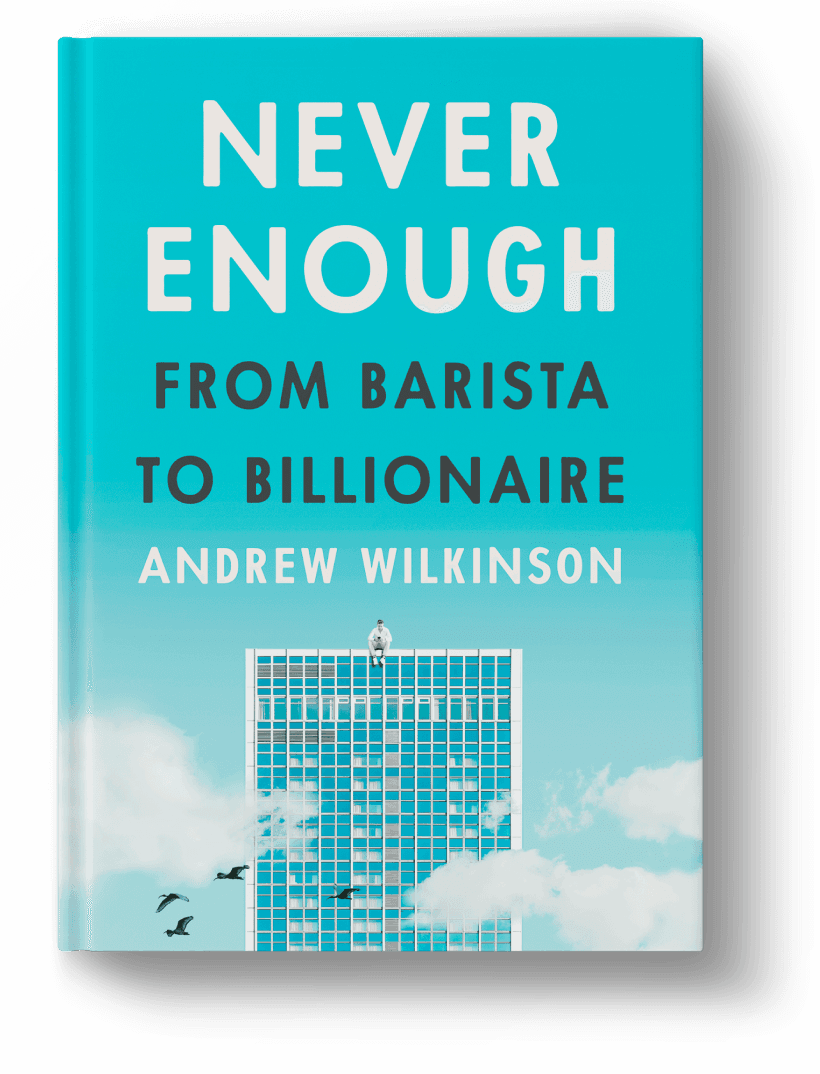
The book
I wrote a book.
320 pages on why having a lot didn’t fix anything. Out now in hardcover, ebook, and audiobook.
Read about the bookKeep reading
The newsletter is free.
Thirty thousand people read it.