Divorce is awesome
Divorce is awesome.
Yes, I know. Clutch your pearls and gasp.
Take a deep breath and bear with me here. I think I'm onto something…
We worship a strange idol in today's society.
The idea that staying married, no matter how miserable, is noble.
That suffering together is somehow better than finding happiness apart.
Many people I know live quiet lives of desperation because of this.
Not everyone. But a good number of people I know are deeply unhappy in their marriages.
They feel unseen and unappreciated.
Like they're always having to explain themselves, but never feel understood.
Like they live with the world's most irritating and critical roommate.
In some cases, it's subtle. In others, it's severe.
It's almost like they have a job they hate—except they're afraid to quit, so they have to share a bed with their boss until one of them dies.
They know how every conversation is going to go. Where it will stall and where it will blow up.
They've tried couples therapy.
They showed up and leaned in.
Learned how to use "I" statements and read the books.
And still, nothing changed.
Because no amount of therapy, communication tools, or self-work will resolve their relationship's fundamental misalignments.
So what do they do?
They give up.
Not loudly, but bit by bit.
They stop bringing things up.
Stop hoping the next conversation will be different and become a quieter, smaller version of themselves—less playful, less open, and less affectionate.
They lower their expectations and let the romantic inside of them—the part of themselves who needs to be seen, heard, and held by a lover—quietly starve to death.
Some cauterize the wound in socially acceptable ways.
They spend all their time with friends.
They get obsessed with working out.
They find stimulation elsewhere.
Anything to avoid being alone with their disappointment.
Others numb it.
A glass of wine becomes a bottle.
A lingering glance becomes an affair.
Or worse, they simply turn off the part of themselves that hoped for more.
They've convinced themselves that they're trapped.
When they open up to friends, they usually say they're staying because they're afraid of losing time with their kids or having to split their finances.
But for most, if you pull on the emotional thread, it's not actually about that—it's about shame.
About admitting they failed at the one relationship society told you was supposed to last forever.
The idea of all the other parents whispering about them at school drop off or becoming a cautionary tale at dinner parties.
Or having to tell their parents their marriage is over.
Why do we fear divorce?
Because even today, a time when over 40% of marriages dissolve, divorce is shockingly taboo.
There's an assumption that marriage must be preserved at all costs—that avoiding the brief pain of divorce is worth decades of unhappiness.
What's bizarre is that breaking up isn't taboo if you aren't married.
Break up with your girlfriend of five years? You get an 'aww' and 'let's go out!'
Tell people you got divorced after five years of marriage and they react with judgement and disappointment.
"Did you try?" they ask in a hushed tone, their face ashen, like you've just confessed to a crime. "I know a great couples therapist I can introduce you to."
It's not just that they think it's sad—that's fine, it is sad—but that they often seem to think it's morally wrong.
I got divorced about 4 years ago, and it was one of the best decisions I've ever made.
I went through all of this.
Do I regret my marriage?
Not for a second.
We have two beautiful sons. We had years of genuine love and laughter. I became who I am in part because of that relationship.
Of course, that doesn't change the fact that we ended up not enjoying being married to one another.
We changed.
Not dramatically. We just grew into different people who wanted different lives.
The person I fell in love with when I was 27 wasn't the same person sitting across from me at 35.
Over time, the relationship shifted.
While we liked and loved one another, we didn't enjoy having our lives intertwined.
We diverged in interests, preferences, and how we wanted our lives to unfold.
And these misalignments came out as blowups over a thousand innocuous decisions.
How to spend Saturday.
How to discipline the kids.
When to take the garbage out.
Each one became a tiny explosion, damaging the relationship. A meta-fight that was really about both of us being in a fundamental conflict that could never be resolved.
Eventually, we both drifted into frustration and stopped trying.
We became incompatible and unhappy. We stopped enjoying one another.
We tried it all: couples counselling. Date night. Taking space.
But in the end, it was simple: we'd just changed.
It just flat out didn't work anymore and we were making one another miserable.
You know what's hard about divorce? Breaking up.
Saying the words. Talking to lawyers. Separating assets. Telling the kids.
That stuff all sucks.
You know what's awesome?
Everything after.
Rediscovering the hobbies you abandoned because they caused friction.
Getting to parent in your own style.
Finding a partner who makes you happy.
Freedom and self-actualization, on so many levels.
But don't forget, this is as much for you as it is for your kids.
I love this line from Dr. James Hollis' incredible book (one of my favorites from the last few years), Living An Examined Life:
"The greatest burden a child can bear is the unlived life of the parent."
He means kids don't grow up in your intentions—they live in your tone, your tension, and your patterns.
When parents stay in a marriage that's quietly miserable, the house becomes a low-grade war zone: tension, sarcasm, silence, little detonations over nothing.
The child adapts by becoming an emotional accountant. Tracking moods, smoothing conflicts, shrinking their needs.
That's the "unlived life." Your fear of making a hard change becomes their job to manage in their own life and future relationships.
You might think I'm exaggerating here, but the science backs this up.
When my ex-wife and I were contemplating separating, I was particularly worried about how it would affect our kids.
I confided in a divorced friend about this, and here's what he told me:
"Here's the hierarchy of what's best for kids:
The ideal is two happy parents who are calm and loving in the same house.
The next best is two happy parents who are calm and loving living separately.
The worst of all, is two miserable parents fighting and modeling a bad relationship in the same house."
I went on to learn that this is backed up by studies.
Researchers tracked 96,000 families and found that kids whose parents stayed in unhappy marriages had higher rates of depression, anxiety, and self-harm than kids whose unhappy parents split up. Staying together was worse.
Another 12-year study found that kids in high-conflict homes actually did better after their parents split.
So many of us martyr ourselves "for the kids" and in doing so damage our children—teaching them that love looks like a festering garbage can of resentment.
And so often, the kids leave for college and the couple finally splits, leaving the children to rewrite their entire childhood.
"So that's why Mom always seemed sad."
"That's why Dad worked late every night."
"Was my childhood a lie?"
They knew. Kids always know. They just didn't have the words for what they were witnessing.
This quote nails the divorce conundrum:
"Easy choices, hard life.
Hard choices, easy life."
–Jerzy Gregorek
Divorce is the ultimate hard choice.
You're signing up for six to twelve months of hell in exchange for forty years of freedom.
You're choosing to crawl through a sewage pipe for freedom like Andy Dufresne because you'd rather spend half a year in the muck than the rest of your life in a cell.
Yes, the conversation with your partner is brutal.
Telling your parents and friends is rough.
Facing the gossip and judgment from others stinks.
(Especially the unhappily married ones who see themselves in your decision and subconsciously hate you extra hard for it.)
Dealing with lawyers and splitting your assets is horrible.
And there's no sugar coating this: your children's reactions are the toughest part.
Then there's the cherry on top of everything: moving out and restructuring your entire life.
All of these things suck. But they suck a lot less spending decades in an unhappy home.
We've collectively decided that divorce is shameful.
But compared to what?
Compared to modeling dysfunction to your kids?
Compared to resentment and bitterness?
Compared to teaching your children that love means suffering?
You know what's worse than breaking your partner's heart, upsetting your kids, dealing with gossip, and spending time with lawyers?
Spending decades in a home filled with resentment, where everyone slowly becomes a worse version of themselves.
It might feel selfish, but it's for everyone else as much as you.
It will allow your partner to find someone who fits them better.
Enable your kids to grow up in two calmer, happier homes instead of one tense one.
And give everyone a real shot at peace—even if the path is rocky.
One of the main reasons that I got divorced was, when I looked around at all my friends, by far, the happiest people had ended their marriages.
It's an open secret among the divorced.
We see each other around and lean in conspiratorially: "Isn't it awesome?"
Almost universally, everyone is glad they separated.
We got to the light on the other end of the tunnel.
And on the other end is self-discovery.
New love and experiences.
Parenting the way you want to.
And often, an even deeper relationship with your kids.
Louis CK puts it well:
"When your friend tells you they're getting divorced, don't go, 'Oh, I'm sorry.'
That's a stupid thing to say. It really is.
You're making them feel bad for being really happy, which isn't fair.
Let me explain something: divorce is always good news.
I know that sounds weird, but it's true—because no good marriage has ever ended in divorce. It's really that simple.
There's never been a marriage where they were really happy, they just had a great thing, and then they got divorced.
That would be really sad.
But that has happened zero times. Literally zero!"
Divorce is hard, but Louis is right.
It's sad and difficult. A hard transition.
But it's one of the best things that can happen to two wrong people and often results in increased happiness for you, your partner, and your children in the long term.
It isn't a failure. It's making a hard choice to have an easy life.
Refusing to sacrifice your remaining decades of life to protect society's feelings.
And yes, like most hard things that require brutal honesty with yourself, it's wonderful in ways you cannot imagine from where you're standing now.
So maybe you should get divorced.
Not all of you, of course. Not if you're genuinely happy.
But if something in your chest just tightened while reading this?
Yeah. You should probably think about getting divorced.
PS: If anyone wants to talk, I'm here.
"The treasure you seek is in the cave you're afraid to enter."
–Joseph Campbell
Also, there's a wonderful book on this topic called Sacred Cows: The Truth About Divorce and Marriage. I recommend checking it out if you find yourself thinking about this.
Originally published in the Divorce is awesome… issue of Never Enough.
Andrew · Victoria · January 8, 2026
Read next
Have babies with the wrong person…
On the birth of my daughter, why young people are obsessed with the prep work of dating but refuse to eat the meal, and why you should just have the freaking baby.
ReadHave babies with the wrong person
On the birth of my daughter, why young people are obsessed with the prep work of dating but refuse to eat the meal, and why you should just have the freaking baby.
ReadI gave $16 million dollars away
What I learned about giving money away—and why scientific research is the part of philanthropy that feels most like venture capital.
Read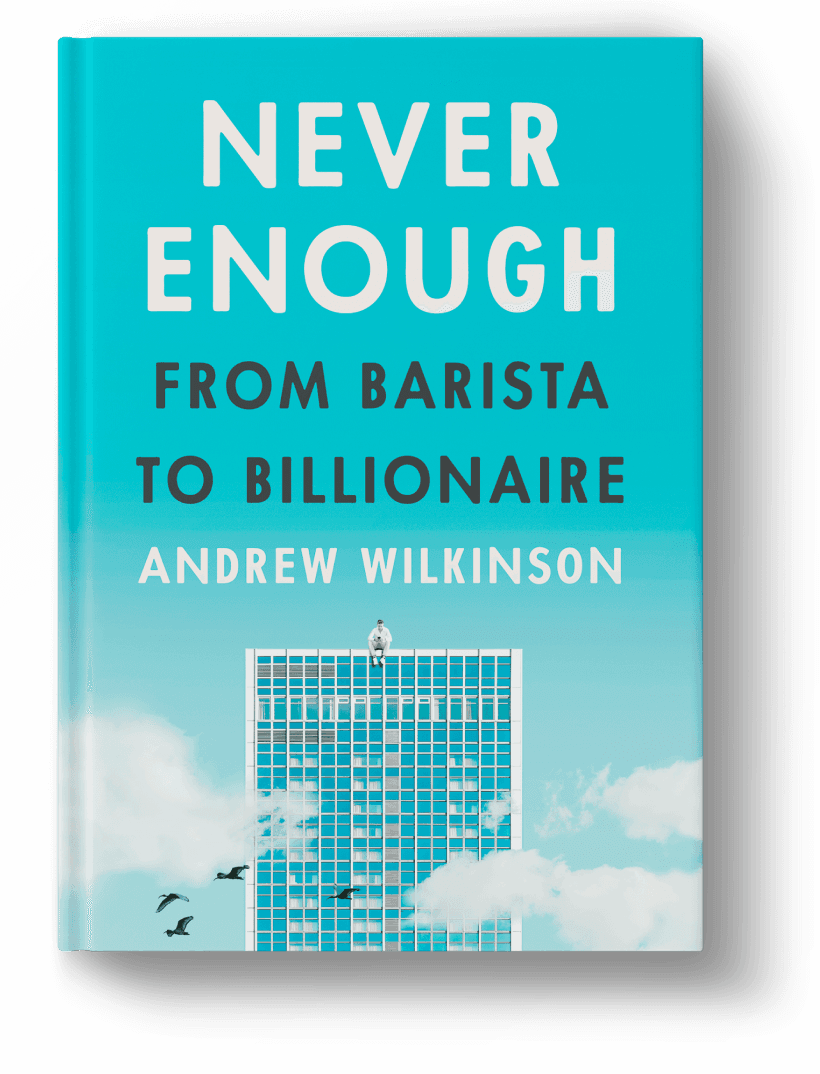
The book
I wrote a book.
320 pages on why having a lot didn’t fix anything. Out now in hardcover, ebook, and audiobook.
Read about the bookKeep reading
The newsletter is free.
Thirty thousand people read it.