I ghosted an army of narcissists...
How my toxic empathy left me surrounded by energy vampires — and the field guide I used to spot high-conflict people and cut them out of my life.
Hello friend,
Why you're getting this: this is my Friends Newsletter, a brain dump of interesting things that I send to interesting people I've met and friends I want to stay in touch with. Zero pressure to stick around—just click unsubscribe if you don't want to get it (don't worry, I won't be notified).
Here's what I'm thinking about…
How to make friends.
Without college roommates, with church and community groups in decline, and now with fewer in-person colleagues (due to remote work), we are ridiculously isolated.
I won’t lie: making friends in middle age is tough, and many of us seek friendship in the wrong way: by trying to become as successful as possible.
As I wrote about in a recent newsletter, that unfortunately backfires.
Over the last few years, one of my greatest obsessions has been learning how to host events and build community.
I learned from the masters: my friends Jayson Gaignard and Nick Gray, who both host incredible events whose entire purpose is to create lifelong friendship and belonging for those who attend (as well as themselves).
So, it was an absolute blast to spend an hour and a half nerding out with Jayson talking all about building community and authentic friendship in a purposeful way.
I think this is my favorite podcast I’ve ever done. Watch/listen here: YouTube / X
PS: Jayson recently wrote an excellent book called Community Made, all about how he builds relationships with interesting people. It’s great.
Are you a good parent?
Most of the time I think I am. Then I take my sons to Whole Foods and I blow my lid.
Dr. Allison Rees has helped me a ton. Earlier this year, Zoe and I attended Sidestepping The Power Struggle, the incredible parenting class that she has been teaching for over two decades.
I loved it so much that I wanted to share her work with my friends, so ELC is hosting an event with her in Victoria on November 2 from 6:30-8:30pm. You can get tickets here.
I ended my relationship with energy vampires.
I have a problem that sounds nice on its surface: I want people to like me and I enjoy helping others with their problems.
My social crack cocaine—my ultimate dopamine hit—is being emotionally of service to others.
When somebody drops that they have a relationship challenge, or that they’re struggling with a coworker, there’s a part of my brain that lights up. “Oooh! I can help!”
This sounds like a good thing—and it can be in some circumstances—but if I’m honest with myself, it comes from a place of insecurity.
If I’m not of value, if I’m not helping, why would somebody like me?
Why I have this weird need to be needed is between me and my therapist, but five years ago, it resulted in a life where I was surrounded by complicated and difficult people.
Some were needy. Others were demanding. Many were manipulative.
In each case, I would make excuses for them.
When a friend would ask me why I tolerated such bad behavior from so-and-so, I’d say something like:
“They had a difficult childhood. It’s not their fault.”
Or:
“I really like the other 70% of them.”
Zoe eventually gave this behavior a label that struck me: Toxic Empathy.
Toxic empathy is when you empathize with others so much that you tolerate and enable their bad behavior, hurting yourself and others in the process.
And I eventually realized it was hurting me. A lot.
Every night I’d spend an hour trying to ensure all the needy people in my life were happy with me, using time I could otherwise spend with friends and family to answer a never-ending wall of hundreds of text messages.
An unanswered message felt like a problem I’d have to deal with later.
If I didn’t reply promptly, I’d get snarky or needy responses or maybe a passive-aggressive comment.
I was like a single firefighter trying to keep a massive forest fire at bay using a garden hose.
I believed that if I just kept spraying—time, commitment, replies, and in some cases even money—at the difficult people in my life, then they would like me and everything would be okay.
I actually liked most of these people. I enjoyed having coffee with them. They were interesting in some way or another.
But caring about them didn’t mean I could change how they treated me.
I just didn’t realize that.
And, of course, you can imagine how this turned out for me…
I’d spent countless hours helping these people through difficult times, yet they seemed to lurch from one crisis to the next. In some cases, I’d even become financially entangled with them.
That only made it harder to admit the relationship was hurting me.
For all the time and energy I put in, I kept coming out worse off.
They were energy vampires, and I kept rolling up my sleeve.
In my friend Adam Grant’s terms, they were “takers.” People who try to get more from others than they give.
The relationship revolved around what they needed, with little room for me or anyone else.
Over the last few years, I’ve been on a mission to cut these high-conflict people out of my life.
If I could go back 20 years and hand my younger self one book, it would be this one:
5 Types of People Who Can Ruin Your Life by Bill Eddy. It’s a manual on how to avoid people with high-conflict personalities where possible and communicate with them when needed.
The hard part is that these people often seem warm, kind, and funny when you first meet them.
But once you get to know them—once they have power over you, or you’re enmeshed with them—the trouble begins.
You know who I’m talking about.
The coworker who makes passive-aggressive comments while chuckling like they’re just kidding around.
The friend who creates drama everywhere they go, blaming everyone else for their troubles.
The partner who has you spending an hour rewriting every text, worried about a blowup.
The colleague who agrees with you in person, then tells everyone else you’re an idiot.
These people become a job that follows you everywhere.
That's where this book comes in handy.
Bill Eddy looks for four red flags occurring together:
-
Intense blame
-
All-or-nothing thinking
-
Poorly managed emotions
-
Extreme behavior
He groups these behaviors into five archetypes:
Note: These are patterns to watch for, not diagnoses to hand out. Not everyone with one of these disorders is high-conflict. Some of these phrases are things anyone might say on a bad day. Look for repeated behavior and what happens when you try to address it or set a boundary.
1. Narcissistic
Your friendship or relationship works beautifully when you admire and agree with them. They seem impressive and make you feel special.
Then disagree. Point out a mistake. Or need something that conflicts with what they want and things suddenly shift.
Now you’re the problem.
Most people think of narcissism as somebody with a huge ego. But it can actually look like the opposite.
Grandiose narcissism is the obvious version: they’re endlessly impressed with themselves—and expect you to be, too. Vulnerable narcissism comes wrapped in hurt feelings and stories about how little they’re appreciated. At the more destructive end, malignant narcissism adds cruelty and retaliation.
In each case, you’re riding in the back seat. Their eyes glaze over when you talk about yourself. Your needs become an inconvenience. Every disagreement becomes a personal attack.
Grandiose narcissism
“Do you know who I am?”
“Honestly, no one else could have pulled this off.”
“Everyone’s always telling me how brilliant I am.”
Vulnerable narcissism
“Fine, I’ll suffer in silence. It’s what I’m used to.”
“I guess I’ll just do it all myself, like always.”
“After everything I’ve done for you, this is how you treat me?”
Malignant narcissism
“You’re nothing without me.”
“I never forget, and I never forgive.”
“You’ll regret crossing me.”
You feel sorry for them. You try harder. You soften every criticism and rehearse how to raise a problem without upsetting them.
Somehow, a request for them to address your hurt becomes another conversation about how much you’ve hurt them. The original problem disappears in a fog of their grievances.
Ask yourself: How do they respond when you say no? Can they admit a mistake without making it your fault? Does an apology lead to changed behavior, or just another round of the same thing?
2. Borderline
In a conflict, you can suddenly go from someone who can do no wrong to someone they see as entirely against them.
Fear of abandonment can make an ordinary disappointment feel like a threat to the whole relationship.
You don't reply to a text because you're in a meeting. You want an evening with your friends. You ask for some time alone.
To you, these are ordinary parts of having a life. To them, they can feel like evidence that you’re pulling away.
Idealization: “You’re the only person who’s ever really understood me. I’ve never met anyone like you.”
Devaluation: “You’re just like everyone else. You never cared about me.”
Fear of being second best: “You always put everyone else before me.”
Fear of abandonment: “You promised you wouldn’t, and now you’re abandoning me.”
The distress can be real and intense. That's part of what makes this difficult: you care about them, and you don't want to be the reason they're hurting.
So you explain. You reassure them. You cancel a plan because it doesn't seem worth another argument.
Over time, you may find yourself editing every text, apologizing for things you haven't done, and checking how they'll react before agreeing to anything. Your world becomes very small.
You start walking on eggshells.
Ask yourself: Is there still room for you to have ordinary needs? Can you disagree, spend time with other people, or say you're tired without it becoming a crisis?
3. Antisocial
They make you feel like you’ve found an ally. They’re charming, confident, and seem to know exactly what you need.
Then the story changes. A promise disappears. Money goes missing. You discover they’ve told different people different versions of what happened.
The pattern here is exploitation with little remorse or empathy.
When I was in my twenties, I used to watch movie villains and think, “Pffft, nobody is actually like that.” I was wrong.
Someone doesn’t have to be Hannibal Lecter to do serious damage. They can be the business partner who lies about where the money went, then acts as if you’re the problem for asking.
Glib charm: “You and I think exactly alike—we’re the only smart ones here.”
Shifting blame: “The team let me down.”
No remorse: “It’s not personal, it’s just business.”
You keep looking for a misunderstanding. You explain why what they did hurt you, hoping that once they understand, they’ll stop.
In the meantime, you’re left holding the bag. They have an explanation for every lie, and you find yourself making excuses for behavior you’d never accept from anyone else.
Ask yourself: What happens after they hurt someone? Do they take responsibility and make it right, even when it costs them? Or do they just get better at explaining it away?
4. Paranoid
Imagine spending an afternoon defending yourself against something you never intended.
You arrive late because your train was delayed. When you explain, your friend says that’s exactly what someone would claim after intentionally keeping them waiting.
It’s a persistent tendency to read hostile intentions into ordinary events. A mistake becomes deliberate. A meeting without them is a conspiracy. A few minutes of lateness can become a personal insult.
It can show up as demands for constant updates, questions about who you’ve been messaging, or messages picked apart for hidden meanings.
Interpreting neutral actions as threats: “You didn’t reply right away because you’re plotting against me.”
Seeing hidden motives everywhere: “You offered to help, but I know you’re trying to control me.”
Escalating ordinary disagreements into betrayal: “You disagreed with me, so you must be working against me.”
You supply more detail. You show them the messages. You explain the invitation, the delay, the thing you didn’t mean.
But each explanation produces a new accusation. Eventually, the relationship revolves around proving your loyalty. You start apologizing for intentions you never had.
Ask yourself: Can a misunderstanding ever be cleared up? Can they accept an explanation and move on, or does every answer become another reason to suspect you?
5. Histrionic
You hear about a falling-out with a friend. It sounds awful. You want to help.
Before long, you’re being asked to take sides, often against people you don’t even know. Other friends have been pulled in. Private details are being passed around, and nobody has checked what actually happened.
The need for attention comes with intense emotion, dramatic stories, and blame. An upsetting event can quickly become everyone else’s emergency.
Recruiting an audience: “Everyone agrees with me.”
Escalating emotional intensity: “This is the worst thing anyone has ever done to me!”
Framing the situation as urgent: “You need to hear what happened right now.”
Pressuring friends to choose sides: “You can’t be friends with both of us after this.”
Sharing a one-sided account: “They completely betrayed me, and I did nothing wrong.”
Inviting public validation: “Can you comment so everyone knows you believe me?”
Discrediting the other person: “Don’t listen to anything they say. They’re trying to manipulate everyone.”
This is easy to get drawn into if you like helping people. There’s an obvious problem, someone is upset, and they seem to need you.
Then there’s another problem. And another person who has treated them terribly. You’re pressured to call someone, carry messages, or join a fight. Ask a question and you’re unsupportive. Stay out of it and you’ve let them down too.
Ask yourself: Are you allowed to care without joining the conflict? Can you listen, ask questions, and make up your own mind without becoming the next person who’s wronged them?
With all of these archetypes, “flying monkeys” may come along too.
You start pulling back from someone. Then a mutual friend gets in touch.
This is a form of triangulation: conflict or communication gets routed through a third person instead of being handled directly.
Pressure to reconnect: “They’re devastated. Can’t you just call them?”
Passing along blame: “They told me what happened. You owe them an apology.”
There’s a funny term for people drawn into this role: “flying monkeys”.
The term references the Wicked Witch of the West and her horrifying army of flying monkeys in The Wizard of Oz.
In The Wizard of Oz, the Wicked Witch controls them with a Golden Cap, which gives her the power to summon them. More enslaved servants than inherently evil creatures.
Accordingly, “flying monkeys” is now also a phrase for people who do someone else’s abusive bidding. It describes people who pressure, discredit, or gather information about someone on another person’s behalf.
The person contacting you may sincerely think they’re helping. They may have heard one version of the story and want to fix it. Bill Eddy describes a related role as “negative advocates”: people whose attempts to help end up reinforcing the conflict.
If your reflex is to rescue people, you can get pulled into that role too. Before you confront someone on a friend’s behalf, ask yourself what you actually know.
This is just a TL;DR guide.
Difficult people come in all shapes and sizes and are often a remix of a few of these high-conflict personality types.
But you know what I’m talking about. Ask yourself if you know anyone like this:
Someone who consistently blames others, refusing to acknowledge their own role in problems?
Someone who tries to recruit you into their conflicts or pressure you to take sides?
Someone whose intense emotions or extreme reactions leave you feeling rattled, guilty, or afraid to disappoint them?
Someone who sees people in all-or-nothing terms, idealizing some and demonizing others?
Someone who impresses you so much that you explain away behavior you’d normally object to?
Something tells me you just thought of a few people in your life. I know I did.
For friendships you can safely step away from, it’s simple, but awkward.
Here’s what you do:
Either just don’t respond, or slowly ghost them.
Thirty-minute replies turn into an hour. An hour turns into a day. And so on.
But the reality is: you don’t owe them constant access to you.
These are not your bags to carry.
You don’t have to respond to every message or accept every invitation. You can just say no. Or nothing at all.
If you feel you have to engage, you can just say something like “I can’t” when they ask to hang out.
No explanation. No further engagement. Just “I can’t.”
If they’re persistent, a related strategy is “grey rock”: keep your replies brief, factual, and emotionally neutral.
Give them less to pull you into an argument.
I remember working with my therapist to build up the courage to do this.
It felt insane. Horrible. Heartless.
But it worked.
When I stopped making myself constantly available, many of these relationships faded away.
I had cut off their supply—I was no longer interesting and they quickly moved on to someone else.
I’m still pleasant if I see them in person. But I don’t spend time with them, and I won’t give them any mental energy.
I no longer let them live rent-free in my head.
In some cases, there were consequences.
Now and then, I hear from their flying monkeys, and I often find out the people I cut off are saying nasty things behind my back, trying to triangulate others against me.
But that is the price of freedom. And it’s worth it.
Texting is fun again.
Looking at my calendar doesn’t make me grimace.
I love my team at work.
I’m no longer doing emotional labour 24/7 keeping all the plates spinning.
Now, of course, if you’re married to one of these people, or they’re in your family, the answer is far more complicated.
I have some recommended reading for you:
Start with 5 Types of People Who Can Ruin Your Life by Bill Eddy. He also did a wonderful interview on Huberman Lab in 2024 (Listen: YouTube / Spotify / Apple Podcasts).
A few other books I love:
Narcissism:
- It’s Not You by Dr. Ramani Durvasula. (Her YouTube channel is also amazing.)
Borderline personality disorder:
- Stop Walking on Eggshells by Paul T. Mason and Randi Kreger.
Psychopathy:
-
Outsmarting the Sociopath Next Door by Martha Stout.
-
Without Conscience by Robert D. Hare.
-
In Sheep’s Clothing by George K. Simon Jr.
-
Snakes in Suits by Paul Babiak and Robert Hare.
Organization guru Marie Kondo asks whether something “sparks joy.”
Ask yourself this question about each of the difficult people in your life.
Do they spark joy, or do they drain your energy?
When you get a text from them, do you feel excited or weighed down?
If you know, you know.
It’s one of the best things I’ve ever done. Trust me, just do it!
PS: If you’re reading this and thinking “oh god, he doesn’t respond to my texts” — don’t worry, you probably aren’t one of the people I’m cutting out of my life (probably). I still have like 1,000 unreads on my phone at all times because I’ve basically declared email/text overwhelm/bankruptcy.
PPS: If you’re reading this and asking yourself “fuck…am I a narcissist (insert other personality disorder)” the answer is probably not, because a true narcissist/psychopath/etc wouldn’t care or recognize this in themselves. That said, many people have sub-clinical levels in some of these traits, and it’s worth deep diving into them to become a better friend, partner, and person in general.
If you’re curious, my personality test, Deep Personality, tests for all of this, as well as anxiety, depression, ADHD, OCD, autism spectrum, and many other mental health issues. It takes about 45 min.
Have you ever tried asking your kids what they did at school today?
Good luck. They clam up and shrug. Best case, maybe you’ll learn they had PE.
Well, Zoe and I have discovered a hack which the boys love.
Each night we go around the table and each of us has to share a rose, a bud, and a thorn.
Rose: Something good that happened today. A highlight.
Bud: Something you learned/are excited about.
Thorn: Something difficult that happened.
It has totally opened their world up to us and resulted in all sorts of fun conversations.
Try it! Magic.
“The grass is always greener over the septic tank.”
—Erma Bombeck
“Where are we at with this?”
Two of my oldest friends, Mark Nichols and Ali Bosworth, both Metalab alumni, just launched Glance, a simple project tracker for agencies.
You can see all your projects on one screen, then send each client a link showing where theirs stands, what happens next, and anything you’re waiting on them for. They can open it without creating yet another account or remembering yet another password.
Mark was employee #3 at Metalab and spent years running projects, so this is a problem he knows well.
If you run an agency, give it a try.
Five AI numbers that sound made up
Brad Gerstner’s 18-minute talk is worth watching if you’re trying to make sense of the AI boom. Five numbers from his September presentation:
-
AI spending is up 1,600% in less than two years. Median enterprise spending has risen 17-fold since January 2025.
-
70% of the Nasdaq’s gains came from one industry. Chipmakers. That was their contribution through September 2026. The people selling the shovels are doing very well.
-
The plan for 2027: more than double the world’s AI computing power. The forecast calls for 43 gigawatts of new capacity, on top of the 37 gigawatts projected to be installed globally by the end of 2026.
-
ChatGPT Codex: 600,000 users to 25 million. In eight months. OpenAI’s tool for writing code grew roughly 40x between January and late August 2026.
-
Grow 30%. Keep the same number of employees. That’s Snowflake’s plan. Uber is aiming for 20% growth without increasing headcount either.
Random Stuff:
😂 I died laughing at this Patton Oswalt bit about killing George Lucas.
🎬 Our Hero, Balthazar is both horrific and hilarious. I absolutely loved it. Watch the trailer.
🏠 I bought a bunch of home organization products from Yamazaki, a Japanese brand. Really nice stuff.
🎵 Lunaris by Bruce Liu is really beautiful (classical album). Listen: Spotify / Apple Music.
🎻 Speaking of classical music, I recently hired a violinist named Llowyn Ball to play at a retreat I hosted for my forum groups. We all sat in a huge circle and listened to him play a few songs, and I will admit I teared up a bit. Highly recommend hiring him if you need someone to play at an event or something.
Victoria Stuff:
🎤 My pals Alex Forman and Nash Park just opened their long-awaited Ok Dope comedy club on Cook Street. They are absolutely hilarious and I can’t wait to check it out!
🎉 My friend Cam who runs Simon Says just opened a really cool third space. Almost every night of the week, there’s all sorts of stuff happening: drawing, book club, movie nights, open mics, etc. So badly needed.
📚 I’m so excited about Meant Well Books, the new bookstore that opened in Estevan Village. They did such an amazing job on the design of the store. It looks awesome! Go buy some books!
-Andrew
Want to read more? Here are a few of my best past issues:
-
Read more past issues here.
Did you enjoy this newsletter? Say thanks by checking out one of my businesses:
Follow me on X: @awilkinson
Follow me on Instagram: @awilkinson
Forwarded this message? Sign up here.
Andrew · Victoria · October 12, 2026
Read next
I ended my relationship with energy vampires
How my toxic empathy left me surrounded by high-conflict people — and the field guide I used to spot the five archetypes and cut them out of my life.
ReadI lied to my kids...
The September 2026 Friends Newsletter: what I’m thinking about, recommendations, and updates.
ReadAre you guys hanging out without me?
On how money and success quietly wrecked my social life — and the rituals I built to become Friend Rich instead. Plus how to be more handsome, ways to make a million dollars, and all my new baby and home tech.
Read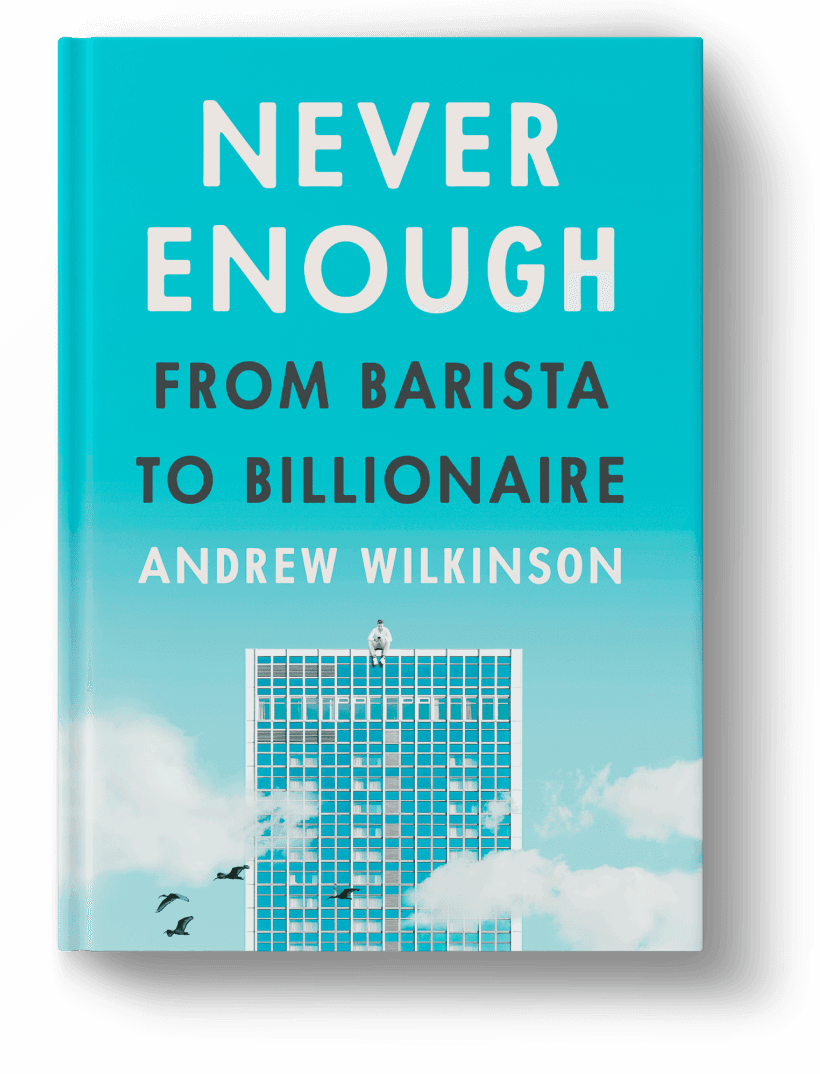
The book
I wrote a book.
288 pages on why having a lot didn’t fix anything. Out now in hardcover, ebook, and audiobook.
Read about the bookKeep reading
Get the next issue in your inbox.
Thirty thousand people read it.