Are you guys hanging out without me?
On how money and success quietly wrecked my social life — and the rituals I built to become Friend Rich instead. Plus how to be more handsome, ways to make a million dollars, and all my new baby and home tech.
Hello friend,
🎟️ EVENT ALERT: I'm hosting an event called Principals in Whistler this October for founders + leaders of family offices. Read on below for details or click here.
Here's what I'm thinking about…
Are you guys hanging out without me?
A strange thing happened when my business took off:
My social life started sucking.
It happened slowly over a few years.
I used to get invited out constantly.
Dinners. Drinks. Parties. Random nights out with friends.
But as my life changed alongside my business, the invitations almost completely stopped.
I was confused.
Did people think I was busy?
Or was it worse? Did they think that I had changed? Or maybe that I would judge them?
When I thought about it, I kind of got it.
I related to the feeling: when I considered someone to be different from me, especially when I couldn't relate to their life, I othered them without thinking about it.
I'd visit their big, fancy house and think:
- I don't want them to see my much more modest house.
- I'll feel intimidated and stressed out if they're around.
- They're on a different level—they wouldn't want to hang out with me and my friends.
Ironically, one of the key reasons I wanted to be successful in the first place was because I thought success would result in an amazing social life.
It was the subconscious loop driving me in my twenties:
Be successful + get money = an incredible life (friends/travel/parties/romantic partners/etc).
When I was young, I thought money was a backstage pass to all the good stuff.
That one day I'd get all the stuff, the bank account, and the recognition, and then suddenly life would be like an episode of Entourage.
But that's not how it works.
Ironically, money makes that harder.
The worst part: the things that make your social life wonderful (friends, community, group activities, etc.) are available for free, with a little effort.
Money actually distances you from others and makes it harder to connect.
It makes you unrelatable.
Even if the person inside hasn't changed, the outside has, according to everyone else.
You're viewed as different. Other. Out of touch.
To use an analogy:
If all your friends drive Volkswagens and one day you roll up in a Mercedes, it shifts things in an odd way.
You just bought this new car. You're really proud and excited about it.
You want to tell your friends about it, and how you worked so hard to get it.
But doing so twists everything in knots. Suddenly they're making comments to one another:
"God, would she stop talking about the Mercedes? We get it!"
"Little miss fancy…"
You've othered yourself.
That's what money and success do to your social life, in a nutshell.
What do people say behind your back?
A few years ago, I paid a psychologist named Jack Skeen to interview my then-wife, closest friends, and co-workers, then write a 360-degree review of my whole life.
What came back was brutal.
By page three, I wanted to crawl under my desk.
It was a non-stop dossier laying out my flaws as a human being.
And while it was miserable to read and triggered a midlife crisis, it was also one of the most valuable things I've ever done.
It felt like ten years of therapy in a month.
The problem with being a human is that you don't experience yourself.
You experience your intentions and the stories you invent to explain your behaviour.
Everyone else experiences your actual behaviour.
Sometimes those are very, very different.
Once a week, I go to a boardroom with six to eight other men, and we talk about our lives.
Personal. Family. Business. Everything.
Everything said is confidential, and the structure keeps the meeting from turning into a very expensive group chat.
It's called a forum, and I started doing it through Entrepreneurs' Organization in 2009.
It's basically group therapy, but if you called it that, nobody would join. So we call it forum.
I love it so much that I've started five of them.
Some of my forum mates know me better than my closest friends.
They've watched me get married, divorced, start companies, break down, get defrauded, have kids, make stupid decisions, and occasionally learn from them.
If you want to start one, don't overcomplicate it.
Find six to eight people you respect, agree that everything stays in the room, meet every month, and ban prescriptive advice unless someone asks for it.
But I noticed a problem:
Things sometimes go unsaid.
The same person talks too much every meeting.
Someone else hides aggression behind a joke.
One person brings the same problem for five years and never does anything about it.
You all notice, but nobody wants to be the asshole who says it.
So I built Forum360 to help my forums do what Jack did for me.
It's really simple: once a year, every member gives feedback to every other member as well as the group itself.
The app anonymizes everything they say using AI, combines it into private reports, and rewrites it so someone can hear the truth without immediately wanting to kill the person who wrote it.
Each person gets the stuff they're great at, the blind spots everyone else can see, and a few concrete things to work on.
The forum gets its own health report and a meeting agenda for talking about what needs to change.
If you're in YPO, EO, Vistage, Hampton, or any other executive forum, I'd love it if you tried it.
Then go make your friends talk about you behind your back.
It's good for you.
Try Forum360 here. I'd love to hear what you think.
PS: This works for any type of group like this. Book club. Wine nights. Anything where you have a group of 5-10 people who get together regularly and want to improve.
STUFF I LOVE:
Your time is valuable, and yet you waste it calling Air Canada to change your flight.
But finding a truly great assistant is rough.
My friends would always say they found someone remote in the Philippines, but whenever I'd try it, it would be a disaster. Poor English and flaky results.
A few years ago, I tried Athena.
It's magical. They train the world's best executive assistants, then pair you up with somebody who knows all the best practices and software and actually teaches YOU to delegate.
It's more expensive than going direct to the Philippines, but more than half the cost of hiring in North America.
So, if you're finding yourself spending your $100/hr time on $10/hr tasks, go hire an Athena assistant.
How to be more handsome.
A couple of years ago, I started wearing makeup.
Kind of.
I was almost forty, going grey, losing my hair, and watching crow's feet appear around my eyes.
I realized if I didn't intervene, I would go bald and my face would slowly transform into a catcher's mitt.
My doctor prescribed me dutasteride, a drug that blocks DHT, the thing that destroys your hair follicles, and a female friend told me to wear face sunscreen.
So I started doing both.
Oddly, on the days I wore the sunscreen, people kept telling me I looked handsome.
It turned out I had accidentally bought tinted sunscreen. It evened out my skin tone.
I was basically wearing make-up and wow, did it ever make a difference.
Women have known about all these tricks forever.
But men have been left out of the loop.
Here's a few easy wins I've discovered in the years since:
Eyebrow threading. Vanquish your unibrow. It takes less than ten minutes and makes a shocking difference. I never even thought about my eyebrows until I noticed a friend looking super sharp one day. He told me he'd just got his eyebrows threaded. One of those things that you wouldn't consciously notice in someone, but makes a big difference. In Victoria, I go to Sunrise Day Spa.
Eyebrow gel. If you have blonde/soft eyebrows, using a tiny swipe of eyebrow gel to slightly darken your eyebrows is also very effective. Make sure you match the color of your eyebrows. Take a photo of your face and ask ChatGPT to help you find the right product.
Tinted sunscreen. I use TIZO3 Facial Primer. It's tinted, matte, and SPF 40. It evens out your skin without making it look like you're wearing makeup.
Botox. This one freaks people out, but it can make you look much less tired in a few minutes. I've had it in my forehead a few times. I once got too much and had a perma-glare for two months, so go to someone who can make you still look like yourself.
The science supports the basic premise: a review of 23 cosmetic studies found people tended to report looking about five years younger after treatment, and a small study using third-party raters found botulinum toxin plus filler made faces read younger, healthier, and more attractive. Repeated treatment may help keep wrinkles from becoming etched in.
Filler. This one freaks people out even more. Everyone I talk to about this goes "BUT IT'S IN YOU FOREVER."
That depends on the injection. The filler I got was hyaluronic acid: temporary, reversible, and generally good for six months or longer depending on where it goes. I got a tiny injection to reduce the bags under my eyes and was blown away by how subtle it was. It took thirty seconds and a poke from a tiny needle. If you're in Victoria, I recommend someone reputable like Cosmedica. When it comes to injecting stuff into your face, don't cheap out.
Stop your hair loss. DHT gradually shrinks genetically susceptible hair follicles. Both dutasteride and finasteride can slow that down, and earlier is better.
I take dutasteride one or two times a week. It blocks both type I and type II 5-alpha-reductase (finasteride blocks type II), and in a large 24-week randomized trial, daily dutasteride performed better than finasteride for hair count and width.
Bonus: Microneedling + topical minoxidil. I started microneedling my hair and beard too. I couldn't grow a beard worth keeping before. The cheeks were patchy, the line was weak. Doing it consistently along the patchy areas and beard line made a surprisingly big difference for me.
My friend Derek from More Plates More Dates runs Intelligent Shop. He sells a very good microneedling pen for $130, replacement cartridges, and fast-drying minoxidil.
A few ways to make a million dollars.
As a general rule, any time somebody says you can "get rich" and "quick" and/or "easy" in the same sentence, you should run away.
Lately I've been spending a lot of time talking to young entrepreneurs and the topic has come up.
After thinking about it for a while, these are my three non-scammy answers (and no, you don't need to spend $10,000 for my Grant Cardone-esque seminar 😂):
1. Find an empty building (strip mall, warehouse, office, etc.) under contract or option. Line up businesses to fill it. Then buy it only once that's locked in.
An empty commercial building is hard to value because it produces no income.
A leased building is much easier: buyers take its annual net operating income and divide it by the market's cap rate.
So an empty building inherently sells at a discount—filling it creates immediate upside.
Here's a simple example.
You get a 10,000-square-foot empty building under contract for $1 million (you have the option to buy it for $1 million).
You line up tenants, then buy it only once you've derisked the whole thing by knowing you've got leases signed.
Spend $200,000 on improvements and leasing costs.
The signed leases produce $140,000 a year of cashflow.
At a 7% cap rate (the valuation metric most real estate investors use to value a building), the building is now worth $2 million.
Your total cost is $1.2 million, so you created roughly $800,000 of value before interest, taxes, closing costs, and all the things that inevitably go wrong.
At an 8% cap rate, it is worth $1.75 million.
At a 6% cap rate, it is worth about $2.33 million.
You can then sell the building or refinance that money back into your pocket (or the next building).
Bonus marks: put your own business in the building.
In Canada, if you own a business, BDC will finance up to 100% of a deal like this if you're moving your business into a building for growth.
So, if you own a business that you can move into a building like this (occupying 50% or more) then you can sometimes do it without putting a cent into the deal.
I did this exact deal for one of our early offices. I had to pay rent anyways — why not — and I made a million dollars of profit when we sold the building a few years later.
2. Buy an existing business.
Every city is full of profitable businesses owned by tired people in their sixties.
HVAC companies.
Sign shops.
Distributors.
Cleaning companies.
The owners' kids don't want them, private equity thinks they are too small, and the owner would often rather finance a friendly buyer than shut the company down.
You don't need an idea.
You need patience, a reasonable down payment (easy to source from local investors—we do this at Folly), and the ability not to screw up an already working business.
My friend Codie Sanchez wrote an excellent book called Main Street Millionaire about exactly this.
Here's the napkin math:
Say a boring company earns $750,000 a year.
You buy it for three times earnings: $2.25 million.
You put down 20%, or $450,000, and finance the remaining $1.8 million over seven years at 8% (often with the seller as the lender).
The annual debt payment is roughly $346,000.
That leaves about $404,000 a year for your salary, taxes, reinvestment, mistakes, and paying the loan down faster.
If the earnings hold and you simply make the scheduled payments, seven years later you own a debt-free business still worth roughly $2.25 million.
You turned $450,000 of initial equity into $2.25 million, while paying yourself a $400,000/year salary along the way.
Of course, earnings can fall, key employees can leave, and debt can make a bad year terrifying.
But you are buying something that already has customers, employees, cash flow, and demand.
That is usually easier than inventing all four from scratch. It's a way to skip the line.
3. Land assembly.
Three side-by-side houses may be worth $3 million separately and $5 million as one development site.
You don't even need to buy them.
You negotiate options or conditional agreements, do the work to assemble the package, then sell it to a developer.
The valuable thing isn't the dirt.
It's the fact that you got three people to agree on something at the same time.
None of these are free money.
Buildings stay empty. Valuations change.
Businesses break.
One stubborn neighbour can destroy a land assembly.
But they are brain-dead simple ways to make a pretty sizable amount of money in a relatively short amount of time.
PS: If you're interested in doing any of these and need a partner, email my partner Ben.
We had a baby ten weeks ago. Here's all the new baby stuff I love.
Sleepytroll Stroller Rocker: You attach it to a stroller or BabyBjörn and it rocks the baby for you. Especially awesome for when you take the baby to a cafe.
BabyBjörn Baby Carrier Harmony: Most carriers are super complex and feel like if you unbuckle the wrong strap, your baby will fall onto the pavement. This one has simple, well-designed clips and breathable fabric.
BabyBjörn Bouncer Bliss: Classic. Still the best.
UPPAbaby Aria V2: I can't believe how light this thing is. Really elegant design and dead simple to use. We have the bassinet, car seat, and stroller.
UPPAbaby Soma Smart Bassinet: Great for casual naps around the house. It adds motion without looking fugly in our living room.
Nanit: None of them are amazing, but the Nanit is the best one. Some nice AI features, like telling you how long the baby has been sleeping and when it was last attended to.
SNOO: Expensive, but we easily get an extra 40–60 minutes of sleep because of it.
A conference for rich, unrelatable people.
I am hosting a very odd event in Whistler in October.
There is a 99% chance you don't want to come.
It's called Principals, and it is for founders, family members, owners, and the senior people trusted to run family offices.
What is a family office?
It's rich-person speak for a personal holding company that manages one family's businesses, investments, taxes, philanthropy, staff, and general financial weirdness.
I know.
I want to punch myself in the face too.
But it is a real job with confusing, high-stakes problems that took me years to understand.
Who should you listen to when every scumbag wants your money?
How do you give your money away effectively?
How do you talk to your kids about wealth without turning them into spoiled brats?
Most family-office conferences are people quietly trying to sell you something.
Principals has no sponsors, no service providers, no panels. Only the people doing the thing.
It's a small, confidential event designed to get everyone to connect and share.
We'll sit around tables, compare expensive mistakes, eat extremely well, and spend enough unstructured time together.
It's October 5–8, 2026 at the Four Seasons Whistler.
If you have a family office (or are in the process of starting one) and want to come, apply here or email me and cc paige@follypartners.com. We have a small number of seats available.
A PERSON I LOVE:
I saw a funny tweet the other day:
"Adulthood is saying 'after this week, things should calm down' every week until you die."
— Signull
Too many people spend decades stressing out, thinking they can finally relax when they retire, sell their business, their kids go to college, etc.
But often, those same decades are spent ignoring your health.
So, when that moment finally arrives, you can't enjoy it because you're suffering from some miserable medical malady.
Most doctors are great at dealing with this problem once it arrives.
"Congratulations, you have cancer. Let's treat it."
My doctor, Avi Reddy, plans ahead so the bad thing never happens in the first place.
He thinks in decades, and optimizes for keeping you healthy and happy into your octogenarian years (your "healthspan" instead of your lifespan).
If you're reading this, I probably like you. So ideally you don't die or live a life of medical misery.
If you want to avoid that, I highly recommend speaking to Avi.
(He's based in the US, but Canadians can work with him)
I accidentally became the IT department for my house.
I've been home a lot more with the baby.
This has caused a predictable and financially irresponsible chain reaction.
First I fixed the Wi-Fi.
Then the cameras.
Then the speakers.
Then I built 100 home automations using Claude, to the point that when someone comes to the door, a British butler voice announces who's at the front door.
My favorite kind of company takes something ugly and complicated, then makes it wonderful.
Dyson did this with vacuums.
Teenage Engineering did it with audio equipment.
And Ubiquiti is doing it with the horrible pile of networking equipment hidden in your closet.
Robert Pera started the company after working as a wireless engineer at Apple.
He looked at enterprise networking gear that cost thousands, required consultants, and seemed deliberately designed to make normal people feel stupid.
Then he made it cheaper and much nicer to use.
UniFi now puts your Wi-Fi, internet, cameras, door access, phones, and other home/business technology into one beautiful interface.
The hardware discovers itself.
The cameras store footage locally instead of shipping every video of your children to a giant technology company.
There are no subscription fees.
And the whole thing feels like it was designed by Apple. It's just beautiful hardware and software.
I'm obsessed, and if you appreciate well-designed products and spent your teenage years fiddling with computer hardware, this will tickle a very nice part of your brain.
I highly recommend upgrading your cameras, Wi-Fi, and home network to UniFi. UniFi now has a proper API, plus an MCP server built on top of it.
In plain English: Claude or ChatGPT can take all the misery out of home automation and make implementing this stuff totally accessible to a layman. It's wild.
Here's some of my other recent home upgrades:
Matic: Because I love Dyson, I bought its new Spot+Scrub AI robot vacuum. The design is great. It automatically empties, cleans, and refills itself. Unfortunately, it gets stuck and the mapping drives me insane. Matic is still the best. I've had one for more than a year and it has never gotten stuck once. It sees cords. It goes around toys. It quietly cleans and doesn't require a search party. You can even just talk to it to get it to clean up after you. INSANE. Watch the demo.
Sonos Arc Ultra + Sub 4 + two Era 300s: A huge upgrade over the original Arc. I expected a slightly better soundbar, but it holds its own against my fancy Atmos home theater setup.
Govee TV Backlight 3 Pro: My friend and fellow gadget obsessive Justin Tse recommended this and it seemed incredibly dumb, but now I love it. A camera watches the television and makes the lights behind it match whatever is on screen. I can't put my finger on why, but it makes a normal TV look way warmer/more engaging.
MOVA LiDAX Ultra 3000 AWD: Robot lawnmowers have gotten unbelievably good. Mine maps the lawn without a boundary wire and leaves it looking like a golf course. The app is a little clunky. The robot itself is amazing. You can now get capable models in this category for around $1,000; mine is closer to $3,000 because I have a lawn with a lot of awkward slopes.
TRMNL X: These things are so awesome. A big 10.3-inch, battery-powered e-ink screen that lasts roughly two to six months between charges, depending on how often it refreshes. I have TRMNL screens all over the house showing weather, PurpleAir readings from sensors near my house, stocks, and calendars. The kids' screens show what they have at school or camp that day, how many days are left until school starts, and when they're going back to their mom's house. I even have one on the door, so when I leave, it reminds me "Don't forget ______" (your workout gear, the kids' backpacks, etc). Amazing for people with ADHD.
Yamazaki Home: A Japanese company that makes household organization products for people who hate household organization products. Really nice.
HOTO: Screwdrivers, drills, tire pumps, and other ugly garage stuff made beautiful. The stuff too boring for Dyson.
Simple Human Cleanstation: We wash our hands religiously, but when is the last time you washed your phone? Gross, right? You put your dirty phone inside, and UV-C light cleans it. Very satisfying.
Nerdy stuff that has made my life better.
Here are a few other things I've been using:
Bee Pioneer Edition: I loved the Limitless pendant, but it stopped working after Meta bought the company. Bee is what I wanted it to become. The battery lasts about a week, it charges over USB-C, and there's a great API.
Every night, I run an automation that looks at my calendar, finds recorded meetings, pulls out the important conversations, and creates transcripts. Then it gives me five funny moments, interesting quotes, or cute things the kids said that day. It's like a very selective diary written by a tiny robot attached to my shirt.
Co-Typist: Magical autocomplete for every text box on your Mac. It watches what you're writing, predicts the rest, and you hit Tab to accept. Didn't know I needed it until I installed it, but it's great.
Raycast: By far the most useful app you can install on a Mac. It replaces Spotlight, window management, clipboard history, snippets, app launching, AI chat, file search, calculator, and dictation. My favorite trick is Quicklinks. Instead of opening YouTube, clicking search, and typing, I hit Raycast, type yt, press Tab, and search. Its new dictation is good enough that I've stopped using Wispr Flow.
Hunter: Almost everyone has a work email. Hunter will find and verify it, or tell you it can't. I've been astounded by who you can reach when you send a short, thoughtful cold email instead of hoping the algorithm introduces you.
NeverSSL: Have you ever joined hotel or café Wi-Fi and the stupid login page refuses to appear? Go to NeverSSL. Because it deliberately uses old-fashioned HTTP, the network can intercept it and finally show you the login page. Bookmark it now. You will eventually need it while standing in a hotel hallway whispering obscenities at your laptop.
I hate taking pills.
But I take a lot of them.
For years, my bathroom was littered with 15–20 supplement bottles. Now I just have a beautiful glass jar full of uniform pills.
VitaminLab takes hundreds of vitamins and supplements and combines your custom formula into one daily packet.
I had Claude review my recent bloodwork and doctor transcripts, then help me draft a formula I can change as my bloodwork changes.
In Canada, MyHealthspan makes it much easier to get broad preventive bloodwork.
In the US, I use InsideTracker.
Really cool. Also a Victoria-based company! Check it out
Coffee upgrades.
I just bought the OPTION-O LAGOM P80.
It looks like Dieter Rams designed a coffee grinder.
It's extremely expensive, extremely overbuilt, and looks like a piece of art on my counter.
I also upgraded my travel setup: an AeroPress Steel and an OutIn Fino.
I love the AeroPress hand grinder when I'm travelling alone, but if I'm making coffee for friends or family, hand-grinding multiple cups, I use the OutIn electric grinder.
The OutIn charges over USB-C and packs down small. Really nice.
At home, I almost always make an AeroPress when it's just me.
But if I'm making coffee for a big group, I use my Ratio Eight.
It brews like a Moccamaster—basically an automatic pour-over—but it's metal, glass, and wood instead of plastic, and the design quality is on another level.
I love it.
The Last Kings of Hollywood.
I really enjoyed The Last Kings of Hollywood by Paul Fischer.
It's about Francis Ford Coppola, George Lucas, and Steven Spielberg going from unknown young filmmakers to completely remaking Hollywood through The Godfather, Jaws, Star Wars, and E.T.
Pure Hollywood popcorn—lots of good stories.
Victoria stuff.
Looking for a great cleaning company? I was really impressed with Touch of Class Cleaners. Great attention to detail.
If you're a Victoria-based entrepreneur with a business that does over $500,000 of revenue, you should apply to join my Entrepreneurs Lunch Club.
We recently relaunched Tasting Victoria after letting it sleep for a year. Victoria seems to be in the middle of a genuine restaurant renaissance, and Zoe has been digging up new openings before almost anyone else hears about them. A few recent issues: two openings nobody knew about, six new reasons to leave the house, and seven openings coming to town. If you live in Victoria and enjoy eating, you should subscribe.
Janevca reopened after its kitchen fire with a new executive chef, Daniele Mereu. I had dinner there and it was really good.
The new Citrus and Cane space is absolutely gorgeous and their food rocks. So impressed. Try the slaw (of all things?).
My favorite lunch spot on Hornby had a fire. If you're a fellow Forage lover, please donate.
Our deli, Ottavio, has a new lunch menu, including meatballs. I highly recommend the meatballs with a green salad. A very nice, healthy lunch.
My favorite Persian place, Niloo, opened a second restaurant called Niloo Chicken & Grill in Esquimalt. The Chicken Inasal is UNREAL. I've been ordering it on DoorDash almost every day. Warning: DoorDash also shows the original Niloo Restaurant in Royal Oak. Choose the Chicken & Grill on Admirals Road or you will order from the wrong place.
Ayoub's makes the best nuts I've ever had. The Lime & Saffron mix and lightly salted cashews are absurd. They're based in Vancouver and apparently coming to Broad Street in Victoria. You can order them online, but only in Canada. My favorite is the low salt roasted cashews and the lime saffron cashews. Trust me on this.
Does anyone need an amazing cabin on Pender Island? My brother is selling his beautiful house. Take a look at the listing here. If you know anyone who wants an island escape, please send it their way.

Andrew · Victoria · August 19, 2026
Read next
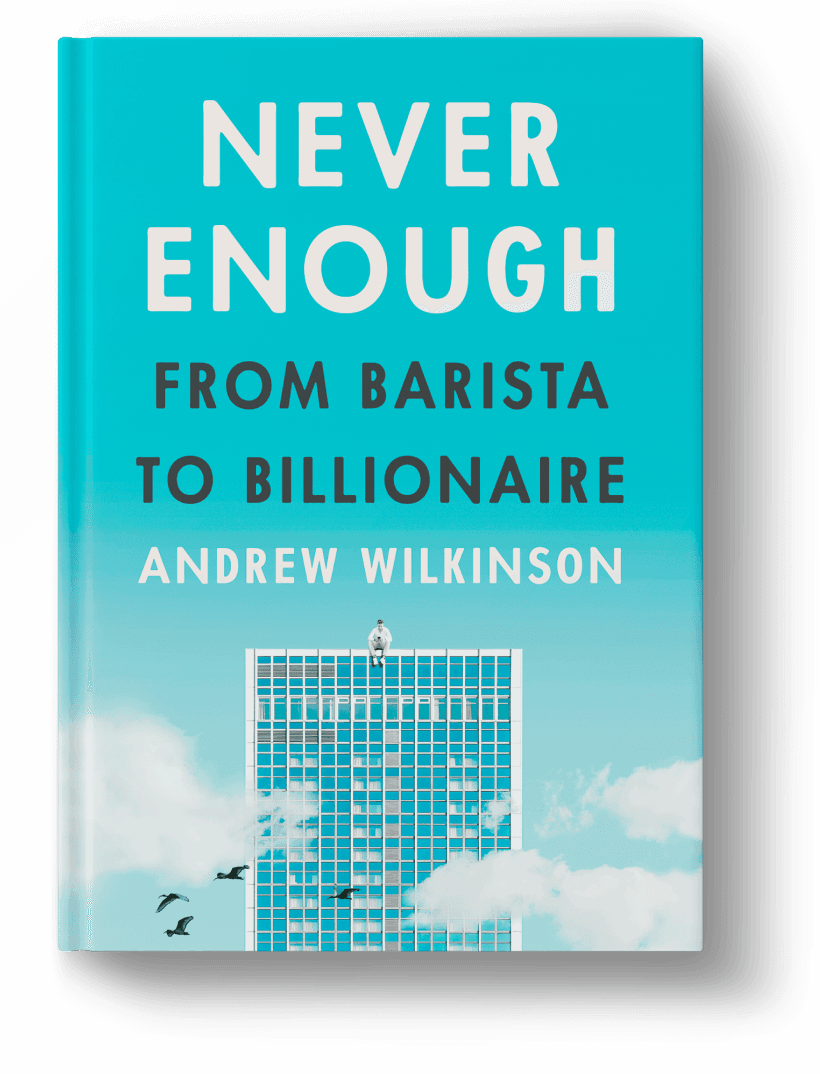
The book
I wrote a book.
320 pages on why having a lot didn’t fix anything. Out now in hardcover, ebook, and audiobook.
Read about the bookKeep reading
Get the next issue in your inbox.
Thirty thousand people read it.