She pushed the needle into my arm
She pushed the needle into my arm. A little poke, a second of discomfort.
No going back now. My palms started gushing sweat.
I lay down on the couch and the nurse passed me an eye mask and a pair of noise-cancelling headphones. I slipped them on while she checked my vitals one last time.
Then darkness.
Nothing.
Minutes crawled by as I listened to the pulse of mellow electronic music and forced myself to breathe.
Why did I agree to this, I wondered. I hated drugs.
I flashed back to that unexpected hug outside my kids' school.
A few months before, I had run into my friend Faisal at school drop-off. He walked right over to me, beaming, and gave me a massive bear hug.
This caught me off guard. It was totally out of character. After all, Faisal doesn't hug. He barely shakes hands. He's the very definition of nonplussed. Always calm, quiet, and controlled—sometimes with a touch of melancholy.
Now, he seemed like a new man. Bright, expressive, and suddenly…a hugger?
As I thought back to this moment, lying on the brown couch in the clinic, a minute after my injection, I started sinking.
Deeper and deeper.
Not into the couch, but through it. The music warped, stretching around me like taffy. My body felt heavy, then weightless, then…just gone.
I melted into something warm and formless. Like my body was dissolving, spreading like cake batter across space.
Then, a few moments later, I died.
At least that's what it felt like.
The injection I had just received was a drug called ketamine, and it had transformed Faisal's life. I was wondering if it could do the same for me.
After battling depression for over 35 years, a single injection of ketamine had taken Faisal from managed melancholy to joyous and thriving in a matter of hours.
His depression had lifted completely. For the first time in decades, he felt light. Free of his mental shackles.
After witnessing his transformation, I went down a rabbit hole of research.
How could this be?
We all know that psychedelics had their moment in the '60s. Hippies. Timothy Leary. Turn on, tune in, drop out. The summer of love.
Then, Altamont and Charles Manson. The government quickly freaked out and banned it all, and for forty years, nobody could even study them.
Fifteen years ago, a few brave scientists at Johns Hopkins and NYU decided to risk their careers and start running trials again. They figured if these drugs were so dangerous, the data would show it.
Not only did the data show that they were safe, but the results have been nothing short of remarkable.
Johns Hopkins found that 80% of cancer patients showed significant reductions in depression and anxiety after a single psilocybin session—effects that lasted six months.
Another study showed that 67% of PTSD patients no longer qualified for the diagnosis after three MDMA sessions.
Wilder still, with small doses of ketamine, a dissociative anesthetic, people whose lives had been destroyed by crippling depression were walking out of clinics crying tears of relief after a single hour-long session.
Selective Serotonin Reuptake Inhibitors (SSRIs), drugs like Prozac and Cipralex have rescued many from depression and anxiety. I know this from personal experience (I've taken Vortioxetine for five years, and it has changed my life). But for many, they leave lingering symptoms, and for some, they don't work at all. These were the people that ketamine seemed to help most — those who had tried everything else, then experienced a miracle.
Before my friend Faisal found antidepressants, it was so bad he sometimes couldn't leave his bed and, at times, even contemplated ending his life. SSRIs had saved him, but they were not completely effective. While he was able to function on them, he still didn't feel like he was at his best. The symptoms were managed, not gone.
But after ketamine, he said that he felt his depression symptoms were nonexistent, and stayed that way for months after treatment.
Faisal's transformation amazed me so much that I decided I had to try it.
But I wasn't depressed. My thing has always been anxiety.
You know that feeling when you're nervous and your palms feel like there's electric current running through them? That tight feeling in your chest, like you can't get enough air to relax?
That's me, 24/7—usually for no good reason.
My brain is a cruel master, constantly warning of looming doom in my health, business, or family if I don't act RIGHT NOW.
Sure, I had moments of calm presence, looking in the rearview mirror, reflecting on past concerns, wondering what I was so stressed about. But it rarely lasted long, and poor sleep, work stress, and a busy life frequently caused my anxiety to boil over.
As they had for Faisal, taking SSRIs had made a profound difference and turned the volume down on my anxiety, but I was curious if ketamine could provide more lasting relief.
To be honest though, I was vaguely terrified of psychedelics. They scared the hell out of me. I'd sworn off recreational drug use years ago, after a five-gram psilocybin mushroom trip that left me wrecked for months.
The way I put it to a friend was:
"When I do mushrooms, it feels like I'm in a hedge maze, and four out of five routes contain a clown with a chainsaw."
So, as you can imagine, I was nervous as hell to try ketamine. But as I researched it more deeply, I was comforted by a few things:
- It only lasts an hour.
- It has a much lower incidence of "bad trips." Ketamine is a dissociative anesthetic, not a classic psychedelic. Users often feel detached from their body/emotions and can gain perspective (rather than confronting the killer clowns directly).
- It's administered in a clinical setting. There's a whole process: doctors' referrals, psychological screening, medical evaluations, therapy and integration. This is actual medicine, administered by actual doctors and nurses who monitor your vitals and can intervene if anything goes wrong.
- It's remarkably safe. It's been used as an anesthetic in hospitals for over 50 years—they even give it to kids having surgery. Unlike other drugs, you can't really overdose on it, and it doesn't suppress your breathing or heart rate.
So, I gulped and signed up for a session at a local ketamine clinic.
Back on the couch that day, tripping balls, something big shifted inside of me.
It felt like I was being dissolved.
Broken down into individual atoms.
That I no longer existed.
That I had died, and this was the in-between space between life and death.
This sounds scary, but oddly, it wasn't. It felt calm and peaceful. Like I'd zoomed out on life and the thing I feared most wasn't so scary after all.
What I experienced during the trips was so abstract that it's difficult to describe, but here are a few things I experienced/felt.
At one point I had a vision of a nuclear bomb blast approaching me. The blast wave rushed toward me, incinerating everything in its path. I should have been terrified, but I wasn't. Just before impact, it stopped. An invisible dome surrounded me and my family and friends.
The realization: me and my loved ones. It was us against the world.
I had this feeling: Keep them safe, and everything will be fine. That it was all that mattered.
Later, new images flooded in. Memories I hadn't touched in decades surfaced.
One struck me hard.
I was eight years old. My friend and I had tricked my younger brother into a wooden box. We slammed the lid and sat on top. His screams echoed from inside, his small fists pounding against the wood. Muffled terror.
Lying there in the clinic, thirty years later, I felt tears stream down my face. I felt his panic, his betrayal. I'd been angry at someone else but took it out on him—the weakest target available.
I felt a deep sense of shame wash over me.
Each session lasted an hour but felt like weeks. As the ketamine wore off, I'd surface slowly, pulling off the eye mask to find myself back in the beige clinic room, saying "Wow..." over and over, like a tripped-out Owen Wilson.
I called my brother right after and apologized for what happened when we were kids—something I'd been carrying around for thirty years like a sharp pebble in my shoe. While he could barely remember it, he appreciated the apology.
This phone call—something I might have felt but never been able to say—was particularly interesting. And I've made many more similar calls after the sessions since.
After wrapping four treatments, I've been struggling to describe the experience.
I told a friend about it over coffee the other day, and I sounded like a lunatic.
"It felt like I got melted down into cake batter, then spread all over the world," I told him, watching his face contort with concern. "And like…nothing really matters except your friends and family."
See, this is the problem with trying to describe a high-dose psychedelic experience. It all sounds completely insane and unrelatable. You end up sounding like that guy at the party who corners you to explain his ayahuasca breakthrough while you slowly back toward the exit.
The imagery and the experience can sound trite. The insights don't seem that deep. Like, I get it, focus on friends and family. Do you really need to trip balls to find this out?
But what's profound about ketamine isn't the wild visuals or the feeling of becoming one with the universe. It's the emotional processing that happens while you're in that altered state.
After my first session, it felt like I'd done ten years of therapy compressed into an hour.
There were emotional wounds I'd been carrying for decades—resentments, frustrations, hurt, many from childhood. After a single session, feelings that had been a screaming 10 out of 10 on the pain scale suddenly felt like a manageable 2.
Like the sharp edges had been sanded down.
We don't yet know the exact mechanism of how ketamine achieves this, but scientists believe it works in several ways.
Your ego temporarily dissolves, so you can examine your life and problems without your usual defensive barriers getting in the way.
The altered state lets you access memories and emotions that might normally be buried or avoided. Your brain's usual filtering system goes offline, so repressed stuff can bubble up and be processed. It felt safe to peek into the dark and scary closets and go skeleton hunting—thoughts I might otherwise keep locked away.
There's also a direct neurochemical effect that provides immediate relief from depression and anxiety symptoms.
But most importantly, ketamine opens what scientists call a "neuroplasticity window."
Think of your brain like a ski hill. Your thoughts are skiers taking the same runs over and over, carving deeper grooves. Depression and anxiety? Those are the icy moguls you can't avoid. Ketamine dumps fresh powder on the whole mountain. You can interrupt and replace old, destructive thought patterns.
So many of us crave annual trips away—a reset, a change of perspective. To me, ketamine felt like a multi-week pilgrimage for my mind, at a fraction of the time and cost.
Each time I pulled off the sleep mask, just an hour later, I felt like I'd gotten back from a three-week trip, wandering through the Himalayas, finding myself. Something had shifted deep inside of me, in the best possible way.
It's been profound in a way that no amount of talk therapy has ever been able to achieve. It helped me work through deeper issues and little traumas that had been bothering me since I was a teenager.
While it hasn't cured my anxiety (I'm still on an SSRI, and unlike Faisal, I didn't experience a major effect on my symptoms), it has allowed me to let go of some of my most unwieldy and unpleasant pieces of emotional baggage.
The result has been a deeper sense of peace and something I've always wanted: a deep, indescribable sense that everything will be ok.
Who knew that all it would take was being melted into cake batter?
Of course, it's not a panacea. In the time since my treatments, I've had many moments of anxiety and existential angst. For me, it was more deep therapy than a biological fix.
Here's what surprised me most: I had zero desire to do it again anytime soon.
Remember that three-week Himalayan trek I mentioned? That's exactly what it feels like. Not something I'd want to do regularly.
Yes, ketamine can be addictive if you start taking it every time you go dancing. But in clinical settings with proper protocols, addiction is extremely rare. This isn't a party drug experience. It's deep work that leaves you feeling like you just climbed Everest and need to process for a while. Most people do an initial 4-6 sessions, then maybe a booster every few months or years.
I've kind of given up on trying to explain the experience. How do you tell someone you became cake batter and found enlightenment? That you died and were reborn four times for the price of a weekend vacation? That an hour lying on a brown couch did what a decade of talk therapy couldn't?
For now, I'm just telling people that, if they struggle with depression, PTSD, or anxiety, they should try it themselves.
If you want to deep dive on ketamine in general, I'd recommend listening to Tim Ferriss's four-hour episode on ketamine with Dr. John Krystal from Yale, who's one of the leading researchers in ketamine's clinical applications. It's been shown to be most effective for treatment-resistant depression, anxiety disorders, PTSD, chronic pain, and certain addiction issues.
If you're interested in trying it, there are reputable clinics sprouting up in most major cities. I did it at SabiMind here in Victoria and had a great experience.
Note: This is my personal experience. Consult your doctor!
Originally published in the She pushed the needle into my arm… issue of Never Enough.
Andrew · Victoria · July 10, 2025
Read next
I gave $16 million dollars away
What I learned about giving money away—and why scientific research is the part of philanthropy that feels most like venture capital.
ReadRewriting fear
When you recall a fear and your body doesn't panic, your brain re-files the memory as 'not a big deal.' That's how I went from sweating through my shirt to cool as a cucumber.
ReadI spent 25 years treating the wrong thing
On waking up in Maui certain I had cancer, the little pink pill that finally turned my brain into a library, and the prison most of us live in without realizing the door is unlocked.
Read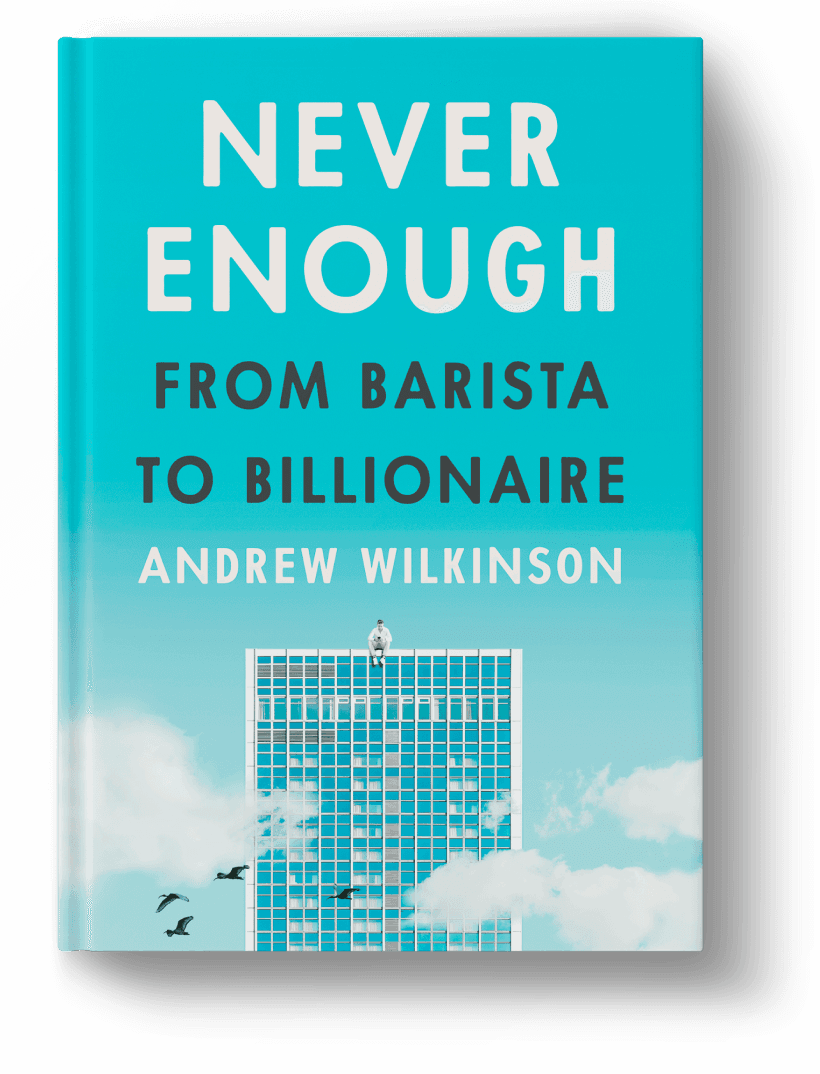
The book
I wrote a book.
320 pages on why having a lot didn’t fix anything. Out now in hardcover, ebook, and audiobook.
Read about the bookKeep reading
The newsletter is free.
Thirty thousand people read it.