I want you to hate me
I want you to hate me.
I want you to read my newsletters and seethe.
To think, "God, he's just THE WORST," as you hate-scroll.
Or mutter "fucking tool" when I say something obnoxious on a podcast, white-knuckling the steering wheel.
Not all of you. Just some.
Maybe 2-3%—that's the sweet spot.
Ten years ago, this would have struck me as insane. I would have wanted the opposite.
Because in 2013 I read a quote that changed my life:
"It takes 20 years to build a reputation and five minutes to ruin it."
This is a famous line by Warren Buffett—someone many of us have modeled our lives after.
This advice, while valuable in moderation, became toxic when I took it to the extreme.
Why?
Because it's impossible.
After reading it, I became obsessed with how I came across to others.
I thought that everyone—online and off—had to walk away from every interaction liking me.
One negative article, one misstatement, one failed commitment, and I'd be toast.
I had to do exactly what I said and follow through. My behavior had to be consistent and predictable.
After all, that's how a reputation is built. Brick by boring brick. Until one day, you die, honorable and forgotten forever.
This idea crystallized one afternoon at a pub with my dad. He had recently retired from architecture, so took him out for a celebratory drink and asked what he wanted to do next.
"You've always wanted to build your own buildings," I said, taking a sip of my beer. "Why not become a real estate developer? With all your contacts, you could get up and running in no time."
"Andrew," he replied, leaning back in his chair. "Once people put you in a mental box, they punish you for leaving it. In their minds, I'm in the 'architect' box. If I suddenly called them up and pitched a real estate development, it would hurt me more than starting fresh. Everyone hates it when you change boxes."
My stomach dropped—I knew he was right. I'd felt it a million times, though I hadn't quite put my finger on why.
Nothing made me cringe harder than the restaurateur friend pitching me on his tech startup. Or my yoga instructor getting their real estate license and trying to sell me a house. Or my lawyer announcing they're becoming a psychotherapist.
I'm ashamed to admit it, but my gut reaction was always: "Stay in your lane."
Which is particularly hypocritical given how often I want to flip flop through everything myself: hobbies, businesses, communities, opinions—you name it. I hate in others what I secretly hate about myself.
We're all desperate to put one another in these boxes. I often get labeled "investor" or "entrepreneur". But even within that, there are sub-boxes. Tech investor, not real estate. Software businesses, not physical products. Bootstrapped, not venture. Crypto skeptic vs. crypto bull. Each label becomes another bar on the cage.
And we love punishing people for leaving it…
David Solomon runs Goldman Sachs, but when word got out that he DJs on weekends? The financial press went apoplectic (I can't imagine they would have said the same if he was golfing).
Jonah Hill starts surfing? Instant meme fodder.
Kim Kardashian passes the bar to fight for prison reform? A vanity project.
Michael Jordan wants to play baseball? Abject betrayal.
We're all prison guards, basically. Making sure everyone stays in their assigned cells.
Why? Because our brains are prediction machines. They get upset when people behave in a manner that doesn't meet their predictions. Thus, step out of your box, and people (and their brains) won't like it.
This happens to me often.
There are people who know me based on my public business persona. They know me as a Buffett wannabe, building a holding company using value investing principles.
This is true. But I also love learning by jumping into random new projects that don't fit this mold.
My portfolio includes all sorts of businesses that would give Warren Buffett hives. I've lost my shirt starting restaurants. Acquired failing newspapers. Invested in companies with a 1 in 100 chance of working.
Tiny continues to buy wonderful businesses at fair prices (the Warren Buffett playbook), but the rest of my life doesn't fit neatly into that "value investor" box.
I am both a disciplined value investor and a creator of chaotic startups across dozens of industries. These two things aren't supposed to coexist.
It's not just me. I recently polled a group of close friends and asked them what they would do for work if they couldn't do their current job.
One response struck me in particular:
A friend runs a huge industrial holding company, but he told me that if nobody was watching, he'd sell it and start his own restaurant.
And better yet, he wouldn't just be the owner. He'd be the chef, sweating it out behind an oven in the back.
His true, authentic passion is cooking, but he feels like he could never step out of the life and reputation he'd established for himself to follow his passion.
What would people say?
That he'd lost his mind, left his successful business in a completely different industry, and gone off to start…a restaurant?
Imagine the gossip and judgement he'd face.
You might think charitably of yourself. That you'd hear that he'd started a restaurant and think, "good for him." But let's be real: you'd likely delight in the gossip and think "stay in your lane," just like everyone else.
Deep inside, you might even subconsciously hate him for it, or want him to fail. Because he did the thing you're too scared to do yourself.
He'd have escaped the same prison you're in. Against the rules. Not fair!
So instead, he continues to do what we all do: shrug and continue to live in society's reputational cage.
I'm sure way too many of you are nodding along. Most of us do this to one degree or another.
I've lived in a cage like this for decades.
This applies to many things. Legal degrees. Bad marriages. Letting down your parents. Moving away from the city you swore you'd never leave. The industry you've spent 20 years building credibility in.
Each, a promise or commitment made by a different person—the person you were before you changed in whatever way it is you've changed. A sort of reputational quicksand, each step out harder than the last.
For me, this obsession with maintaining reputation—playing by these inflexible rules—was a recipe for misery.
If I continued playing the game, I had three equally terrible options:
Terrible Option 1: Hide and say nothing. Fly under the radar. Be a cipher. (Impossible, for an extreme extrovert like me.)
Terrible Option 2: Become a caricature of myself. A personal brand instead of a person. Avoid doing anything controversial.
Terrible Option 3: Live a double life. Perform one thing and do another in secret. The world wouldn't catch on and give me the corresponding social beating, but I also wouldn't get to share my passion with others.
For a long time, I chose Terrible Option 3. I toned down the things I mentioned publicly and didn't talk about many of my projects because they didn't fit the template.
It felt inauthentic. Like, with every passing day, a little piece of me was dissolving.
I realized it had gone too far when I found myself deleting a tweet for the fourth time. Not because it was wrong or offensive, but because someone, somewhere, might misinterpret it.
I was slowly drifting towards becoming what I'd always mocked.
A corporate politician. A beige person. Human vanilla extract.
Then, in January, I came across a book called The Courage to Be Disliked.
I needed this book. So much that I actually felt personally attacked by it.
The core message is that seeking recognition from others is a trap.
We bend ourselves into pretzels trying to meet everyone's expectations, but it's impossible. You literally cannot make everyone happy. And trying to do so means living someone else's life, not your own.
The book argues that having the courage to be disliked is the only path to freedom. Not by being an asshole, just accepting that living authentically means some people won't like you.
Reading it felt like someone finally handed me the keys to my own cell.
It gave me permission to start breaking the rules. I was done with the likability game. I was going to have the courage to be disliked. Hated, even.
To live authentically, I would do what I wanted to do, and talk about what I wanted to talk about, so long as it didn't hurt anyone else in an unfair way.
Change my mind. Be unpredictable. Jump around.
That became my 2025 resolution.
Now, to be clear, we're talking about a very specific type of reputation. What the public at large thinks about you.
Should you maintain a reputation as a fair and ethical partner, whether it's romantic, social, or business?
Absolutely.
But should you obsess over what the world would think, as Mr. Buffett puts it, imagining every action appearing on the front page of The New York Times?
In most situations, absolutely not.
I stopped playing for universal approval. I chose the courage to be disliked. That means I'll say things some people won't like, and I'm okay with that.
Disappointing people is the price of an authentic life.
So here's my dare:
Let someone down today. Say the thing that's been rotting in your chest.
Start small. Post your anime fan fiction. Tell your gym bros you love Pilates.
Then, go bigger. End the relationship everyone thinks is perfect but is actually miserable. Admit what you thought was your dream job is a nightmare. Tell your business partner you want out. Stop pretending you enjoy the thing that's slowly killing you.
Watch what happens: 90% won't notice or care. 8% will respect you more. 2% will hate you.
And you'll feel free for the first time in years.
Because here's what I learned: The cage only exists if you believe in the bars.
I'd rather have 2% hate the real me than 100% applaud a performance.
PS: Thanks to all you hate-scrollers. I couldn't do it without you.
Originally published in the I want you to hate me issue of Never Enough.

Andrew · Victoria · September 4, 2025
Read next
I gave $16 million dollars away
What I learned about giving money away—and why scientific research is the part of philanthropy that feels most like venture capital.
ReadRewriting fear
When you recall a fear and your body doesn't panic, your brain re-files the memory as 'not a big deal.' That's how I went from sweating through my shirt to cool as a cucumber.
ReadI spent 25 years treating the wrong thing
On waking up in Maui certain I had cancer, the little pink pill that finally turned my brain into a library, and the prison most of us live in without realizing the door is unlocked.
Read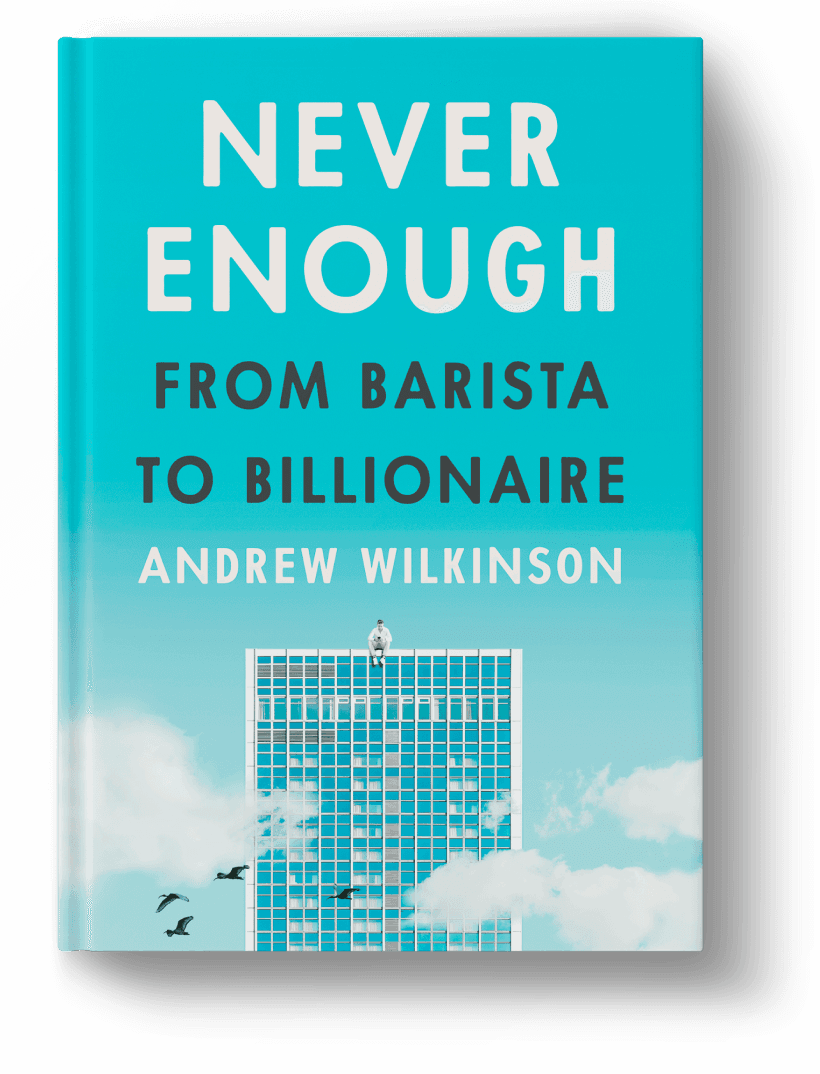
The book
I wrote a book.
320 pages on why having a lot didn’t fix anything. Out now in hardcover, ebook, and audiobook.
Read about the bookKeep reading
The newsletter is free.
Thirty thousand people read it.