I asked ChatGPT to be my relationship coach
In my last newsletter, I wrote about divorce.
Many readers emailed me, telling me they felt some of these feelings but weren't ready to separate from their partner.
That they wanted to fight—to work through their differences.
I might have something that could help your relationship… (or maybe help you work through an existential crisis—or trigger a new one)
Last month, Zoe and I sat in our den with our jaws on the floor.
We were in front of my laptop, taking turns reading a report out loud, line by line.
The document read like a CIA dossier—incisively breaking down each of our repeated fights and nailing our relationship dynamics.
We had to laugh. We couldn't believe it.
A few days earlier, I'd asked ChatGPT a simple but loaded question:
"What information would you need in order to become the ultimate personalized relationship coach?"
It replied with a long list of personality tests—the same ones psychologists use to evaluate mental health, personality, and relationship satisfaction, and a ton more.
The tests were all available online, but scattered across annoying PDFs and awkward, old-school forms. For someone with ADHD, like me, the idea of doing them one by one was pure torture.
I just wanted to pound through them as one big test.
So I asked Claude Code to build a simple app that combined them.
I listed all the tests I wanted and asked it to build a web app that would combine them. I'd done some vibe coding last year with tools like Replit and Lovable, but nothing prepared me for how good Claude Code has become.
Within a few hours, I had a beautiful web app that combined all of these tests into one.
When I say beautiful, I mean it looked like I employed a $50,000-a-month payroll of talented designers and engineers who'd spent two months working on it.
Except I didn't have a $50,000-a-month payroll.
I'd paid Claude around $500 in AI credits — and what would normally take months had taken hours.
Crazier yet, I'd just talked to it like it was a human employee.
Once a beta version was ready, Zoe and I completed our tests and exported our results into ChatGPT—no names, no context—and asked:
"Based on this couple's psychological test results, tell me as much as you can about their relationship."
That's how we ended up in our kitchen, in shock, as ChatGPT broke down our relationship patterns with eerie precision.
How my ADHD makes me want quick resolution, while Zoe needs to talk things through.
How her high openness craves novelty, while I'm a stick-in-the-mud who craves routine.
How my avoidance causes me to pull away and shut down when I'm stressed.
It felt like a report written by a world-class therapist who'd spent dozens of multi-hour sessions carefully dissecting our dynamic and suggesting remedies.
It told us where we were most compatible, and where we'd struggle if we didn't put in the work.
It even wrote personal deep dives on each of us, our personalities, and our individual gifts and challenges.
And it knew all of this from 45 minutes of multiple-choice questions.
I started thinking about friends who'd never been to therapy, or couldn't afford anything like this, and how much it could help them.
That's when I realized this was a business.
Something that would solve a valuable problem for a lot of people.
So I got to work.
For the last month, I've been jolting out of bed at 5:30 a.m., too excited to sleep, obsessively building this product.
And today, I'm excited to launch Deep Personality.
I think it's one of the most comprehensive mental-health screening tools on the internet.
It's not a replacement for professional help, but a roadmap to it.
Most people stumble blindly into a random therapist or doctor's office without knowing what type of treatment they are even trained in or its efficacy for their specific problems.
Deep Personality will screen you across 30+ mental health conditions and provide you with a detailed roadmap of how to get the help you need.
In under an hour, it gives you a high-signal snapshot of your mental health across dozens of dimensions:
Big Five Personality The gold standard for understanding why you do what you do.
Attachment Styles The hidden patterns behind pushing people away, clinging too tightly, or choosing unavailable partners.
Anxiety & Depression Screens for what you might be dismissing as "just stress."
Relationship Satisfaction Measures the real health of your relationship — often surfacing problems you've been avoiding.
Sensory Processing Why crowded rooms drain you — or why you need things just so to focus.
Neurodivergence Flags potential ADHD and autism-spectrum traits that often go undiagnosed into adulthood.
Trauma Maps early experiences shaping your triggers and stress responses.
Values & Career Fit Shows what actually motivates you, and why some work quietly drains your soul.
You can do this individually, or compare yourself to anyone in your life.
This is where it gets really interesting...
Have your partner, coworker, friend, or family member take the assessment, upload their profile, and wait while the app analyzes your personalities and how they interact with one another.
For romantic relationships, it analyzes attachment compatibility, conflict styles, emotional regulation, and values alignment — telling you exactly where you'll clash and what to do about it.
For work relationships, it focuses on communication, motivation, and how you'll collaborate — or blow up under pressure.
For friendships, it looks at shared values, social energy, and the dynamics that help relationships thrive (or quietly fade).
For Zoe and me, having our relationship laid out with this kind of clarity — patterns we'd felt but never articulated—was deeply meaningful.
Once you complete the assessment, you get a 50+ page deep dive on your personality.
It felt like finally getting the owner's manual for myself. You also get a custom AI prompt pre-loaded with your psychological data.
Drop it into ChatGPT, Claude, or any AI assistant — and you have a therapist who already knows your attachment style, anxiety patterns, values, trauma history, and emotional regulation tendencies.
No more spending six therapy sessions explaining who you are.
The AI already gets it.
And if you're in therapy, or going to start with a new therapist, you can also export a clinical PDF designed for practitioners—raw scores, thresholds, severity flags, discussion points, and citations.
Or… it can help you attract your perfect romantic partner.
This one's just fun.
Deep Personality can generate dating bios based on your actual personality data — tailored to Hinge, Bumble, or Tinder — in tones like witty, sincere, adventurous, or intellectual.
The AI turns what makes you unique into something that attracts compatible people.
Once it knows you, it helps you get the help you need. Based on your results, it recommends books, podcasts, and treatment options backed by peer-reviewed research.
The full assessment covers 30+ psychological screens and 300+ questions, and it costs a fraction of a single therapy session (free for the basic analysis, $19 for the full report, $29 for a couples comparison).
It's really crazy. I think it's going to blow your mind.
Who is this for?
- High achievers who want to understand their edge
- People who feel stuck and don't know why
- Curious minds who want real data
- Pattern repeaters, same story — different chapter
- Anyone who wants better relationships
I'd love it if you'd try it and send me your thoughts!
Click here to check it out: https://deeppersonality.app
Originally published in the My name was in the Epstein files… issue of Never Enough.
Andrew · Victoria · February 11, 2026
Read next
I gave $16 million dollars away
What I learned about giving money away—and why scientific research is the part of philanthropy that feels most like venture capital.
ReadRewriting fear
When you recall a fear and your body doesn't panic, your brain re-files the memory as 'not a big deal.' That's how I went from sweating through my shirt to cool as a cucumber.
ReadI spent 25 years treating the wrong thing
On waking up in Maui certain I had cancer, the little pink pill that finally turned my brain into a library, and the prison most of us live in without realizing the door is unlocked.
Read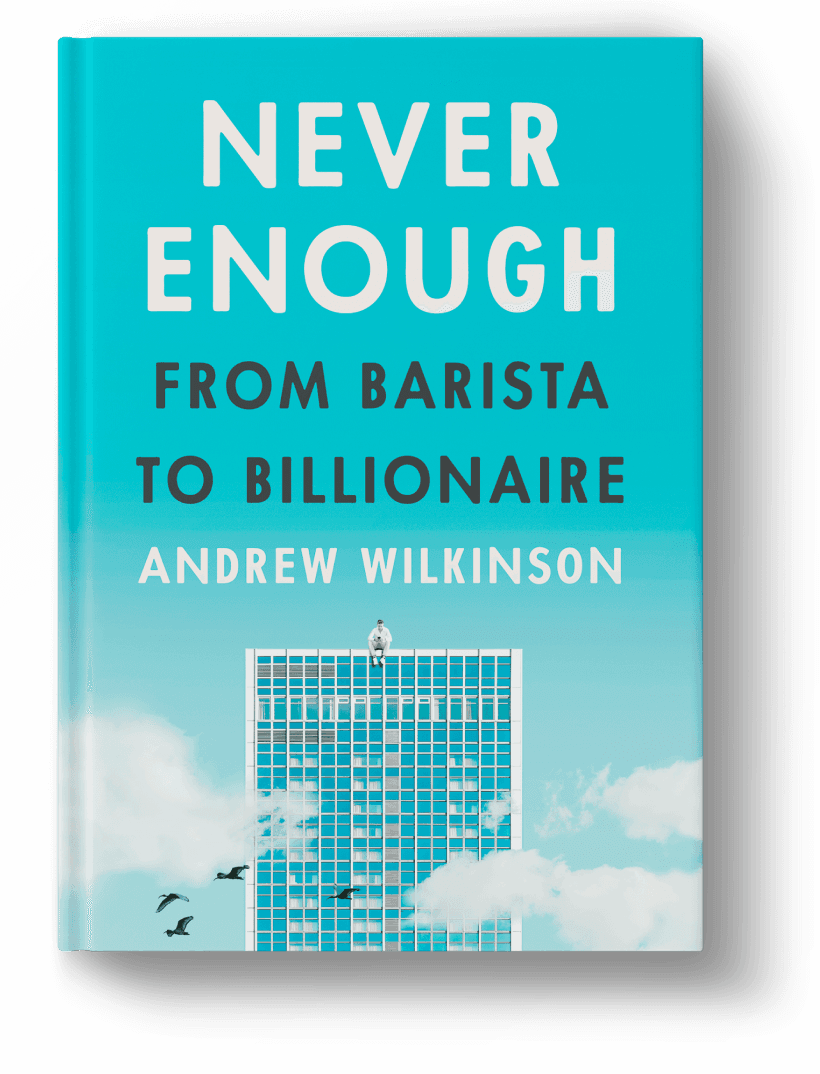
The book
I wrote a book.
320 pages on why having a lot didn’t fix anything. Out now in hardcover, ebook, and audiobook.
Read about the bookKeep reading
The newsletter is free.
Thirty thousand people read it.